The Man Who Was Thursday by G. K. Chesterton — a book for the night: the opening, the author and a London trail
A topsy-turvy detective story and a philosophical joke: a poet is recruited into the police and infiltrates a council of anarchists who have taken the names of the days of the week. The opening in the original and our translation, the author and a London trail — places checked today.
Thanks for £1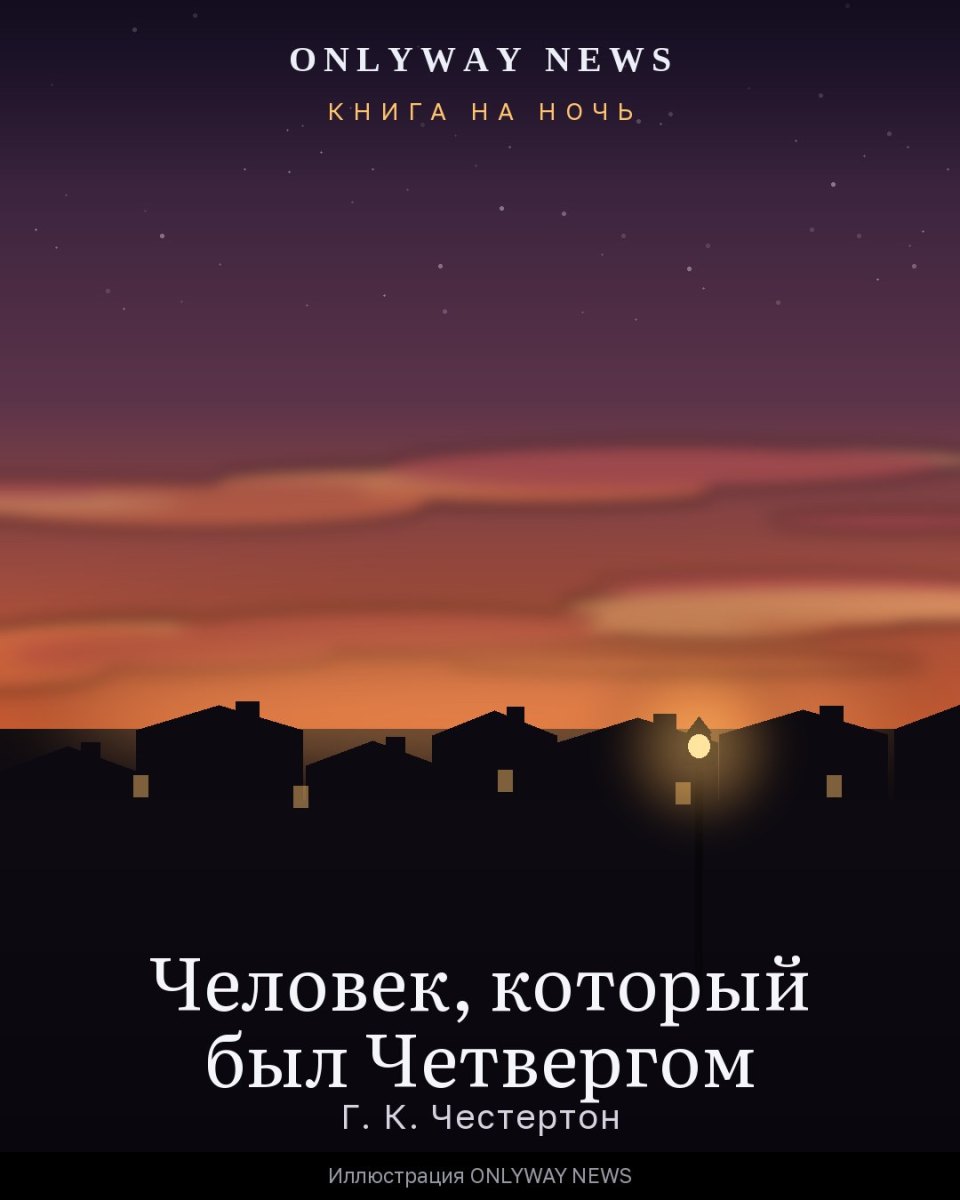
Late in the evening it is good to open a book that is itself like a dream — and The Man Who Was Thursday is exactly that: Chesterton subtitled it “A Nightmare” for a reason. It is a topsy-turvy detective story and a philosophical joke at once. A young poet, Gabriel Syme, is secretly recruited into a police force that fights anarchists, and he works his way onto their supreme council — seven conspirators who have taken the names of the days of the week, led by the vast and mysterious Sunday. What follows is a chase in which everything turns upside down, each twist stranger and funnier than the last. It reads lightly and fast, like an adventure, yet by morning what stays in your head is not an adventure question at all — about order and chaos, and who really stands behind the world.
The opening: how the book begins
The novel opens not with a chase but with a sunset over a London suburb — the very picture we took for today’s cover. The first line:
“The suburb of Saffron Park lay on the sunset side of London, as red and ragged as a cloud of sunset.”
And here is the exchange the book is loved for quoting. The anarchist Gregory insists that poetry is revolt and chaos; the poet Syme answers that poetry lies in order — in a train that comes in on time. Gregory throws out: “…the most poetical thing in the world would be the Underground Railway.” And Syme calmly replies: “So it is.”
The full text in English is free and legal: Project Gutenberg, eBook #1695.
Why it is worth reading tonight
The Man Who Was Thursday pretends to be a spy thriller about bomb-throwing anarchists, but it is really a book about how a frightening, hostile-looking world may turn out to be nothing like what it seems. Chesterton was the “prince of paradox”: he turns a familiar thought inside out so that you laugh first and think afterwards. The chase across London slowly becomes a chase after meaning, and the comic plot a conversation about goodness, order and faith — without a single dull page. The first chapter, two poets meeting in a sunset-lit Saffron Park, takes about ten to twelve minutes read aloud and sets the tone at once: light, ironic, faintly uneasy. We won’t give away the ending; we’ll only say that the riddle of who Sunday is remains one of the most argued-over in English literature, and every reader answers it differently.
About the author
Gilbert Keith Chesterton was born on 29 May 1874 in Kensington, London, and died on 14 June 1936 in Beaconsfield, just west of London — more than seventy years ago, so his writing is now in the public domain. Three things about him. First, he was a huge, cheerful, endlessly witty journalist nicknamed the “prince of paradox,” whose short inside-out aphorisms are still quoted. Second, he invented the priest-detective Father Brown — one of the most endearing sleuths in fiction — and wrote dozens of books, from novels to theology (Orthodoxy, also 1908). Third, in his lifetime he debated in print, as a friend, with Bernard Shaw and H. G. Wells, and that honest, good-humoured argument made him a model of British commentary. He is buried in Beaconsfield; his gravestone was carved by the sculptor Eric Gill.
 ADV · A001ONLYWAY JEWELRY — gold, silver and platinumRings, chains, bracelets, earrings and pendants. Delivery across the UK.Advertise here
A trail through the places
Chesterton’s trail is a London one, with a single out-of-town point. All three places are free; the conditions below were checked today.
Bedford Park, Chiswick, London W4 — the very “sunset-side” suburb: this is what Chesterton put into the novel as Saffron Park. It is Britain’s first garden suburb (built from 1875), a quarter of handsome red-brick houses with sharp gables — exactly the roofs on our cover. You can walk the streets any time, free; the nearest Underground station is Turnham Green. It was here, in Bedford Park, that Chesterton met his future wife, Frances.
Blue plaque, 11 Warwick Gardens, Kensington, London W14 8PH — a memorial plaque on a house where Chesterton lived. It reads: “Gilbert Keith Chesterton 1874–1936 Poet Novelist and Critic lived here” (put up by the London County Council in 1952). The plaque is on the building’s front — you can see it from the street any time, free.
Beaconsfield, Buckinghamshire — the small town west of London where Chesterton spent the second half of his life and where he is buried. His gravestone (carved by the sculptor Eric Gill) stands in the Roman Catholic cemetery on Shepherds Lane, about twenty-five metres north of the entrance building. The cemetery is open and free; this is a day trip out of town.
Where to get it
Free. The full English text is in the public domain: Project Gutenberg, eBook #1695. To find it in British libraries, use the Library Hub Discover catalogue.
Buy. English editions are held by ordinary British bookshops (Penguin and Dover keep it in print). A Russian translation of “Человек, который был Четвергом” (the classic one is by Natalya Trauberg) has long been in print — look for it at Britain’s Russian bookshops Notre Locus and Bookashka; check stock and price on the shop’s site.
Thanks for £1If this information was useful and came in time, press the heart. Payment goes through PayPal, with nothing to choose and nothing to fill in, and it pays for the newsroom.
- The Man Who Was Thursday: A Nightmare by G. K. Chesterton (1908) — Project Gutenberg, eBook #1695 (полный текст; первая фраза; диалог Сайма и Грегори)
- G. K. Chesterton — born 29 May 1874, Campden Hill, Kensington; died 14 June 1936, Beaconsfield; buried Roman Catholic Cemetery, Beaconsfield — Wikipedia
- English Heritage blue plaque — Gilbert Keith Chesterton, 11 Warwick Gardens, Kensington W14 8PH (LCC plaque, 1952)
- The Man Who Was Thursday — Saffron Park parodies Bedford Park, Chiswick; Chesterton met his wife there — Wikipedia
- GK Chesterton tomb (by Eric Gill), Beaconsfield Cemetery, ~25 m north of the entrance building — Historic England listing
 Books
English Fairy Tales by Joseph Jacobs — a book for the night: the Whittington tale and a London trail
 Books
Frankenstein by Mary Shelley — a book for the night: the opening, the author and a London trail
 Books
Hugh Lofting’s “The Story of Doctor Dolittle” — bedtime book: extract, author and a Maidenhead route
- Money Debt management plans in the UK: pay less, and never pay for advice
- Jobs & Business UK gender pay gap reporting: who must report and by when
- Money GBIS: free home insulation in Great Britain — who qualified
- Life Where to buy the food you grew up with in London: Russian, Ukrainian, Polish and Baltic shops
- Life Pupil Premium: the extra funding English schools get for disadvantaged pupils
- Money How to switch energy supplier in the UK and whether it is worth it
- Immigration UK visa waiting times in 2026: the official UKVI timelines and how to get a decision in a day