The Romeo and Juliet mural
This rose-covered facade in Shoreditch stands on the 1577 theatre where Romeo and Juliet was first staged.
Thanks for £1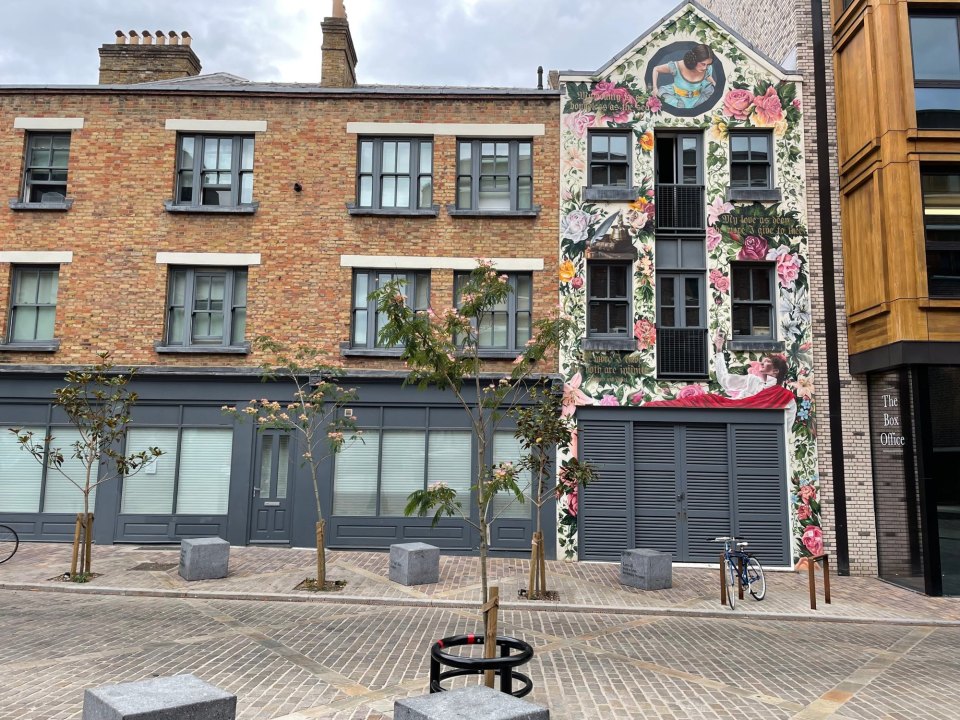
A facade of roses, a young man in love with a smartphone, a woman in a medallion and the lines "My bounty is as boundless as the sea" — this is not just a pretty mural. It marks one of the most important places in the history of English theatre. Here it is in business terms: what this building is, why Romeo and Juliet is painted here, who built it all and what it costs.
What is this place?
This is The Stage quarter in Shoreditch (east London). The mural is devoted to Romeo and Juliet for a reason: right here in 1577 stood the Curtain Theatre, and on its stage, historians believe, Romeo and Juliet — as well as Henry V — was first performed. So this is one of the places where Shakespeare's theatre was born, and the lines on the wall are quotes from that very play.
How was Shakespeare's theatre found?
A story like a film. The exact site of the Curtain was long disputed, until in 2012 archaeologists dug up its remains right under the ground of the future development — just three metres below the surface. Walls, the yard for spectators and even objects of the era were found. It is a sensation: almost no physical traces of Shakespeare's theatres survive, and the Curtain is a rare exception.
 ONLYWAY NEWSLIVELife · 27.11The Romeo and Juliet muralMoney · 27.11Apps for renting and buyingLife · 27.11Walking in the English countrysideMoney · 27.11What a small flat costs to buyLife · 27.11Wheelchair space on a bus: rightsLife · 27.11Foraging: the lawMoney · 27.11What charging an EV costsMoney · 27.11Reserved in London: who owns itMarkets · 27.11Petrol 157.3p, diesel 189.7pMoney · 27.11London taxis: cab vs minicabONLYWAY NEWS · appInstall the ONLYWAY NEWS appFresh UK news, classifieds, key dates and exchange rates on your home screen, one tap away. Free.NewsClassifiedsCalendarRates
What was built here?
On this site rose the large modern quarter The Stage, worth £750m. It has 412 flats (from 416 sq ft studios to 2,434 sq ft penthouses), a 37-storey tower, over 257,000 sq ft of offices and about 9,000 sq ft of shops and bars in the restored viaduct arches. And the excavated remains of the Curtain were preserved right inside the quarter as a cultural centrepiece — in the open air, free to the public.
Who built it and who earns?
The developer is Galliard Homes with investor partners. Their logic is clear: proximity to living Shakespeare history is powerful marketing that lifts the price of flats and rents. The mural and the preserved theatre work for the brand of the place: a beautiful legend makes property dearer. The main beneficiary is the developer and investors, and also the area, which gained a new draw.
Who paints such murals and what do they cost?
Large murals in London are a whole industry. Developers and brands commission them from artists to "enliven" a wall and draw attention; a big facade painting costs from a few thousand to tens of thousands of pounds. The city even holds a London Mural Festival. For a developer it is cheaper than advertising and lasts longer: such a facade collects photos on social media for years — free promotion for the quarter.
Why should a newcomer go there?
It is free and three things at once: a beautiful mural for photos, a piece of genuine Shakespeare history underfoot, and an example of how London turns the old into money. The remains of the Curtain Theatre can be seen right in the courtyard of The Stage quarter, by Shoreditch High Street station. A tip: come on weekdays and by day — fewer tourists, and better light for photos.
Thanks for £1If this information was useful and came in time, press the heart. Payment goes through PayPal, with nothing to choose and nothing to fill in, and it pays for the newsroom.


- Tax Self Assessment: 31 Jan deadline
- Money Do marketplace warehouses give goods away free? The truth about unclaimed parcels
- Law Yellow and red kerb lines: UK rules
- Travel Next-generation airport scanners in Britain: what changes and what can be searched
- Life Royal week: Prince George starts at Eton, Prince William at King Harald's funeral
- Immigration UK Standard Visitor Visa in 2026: Rules, Fees and Duration