Living walls on buildings
The green facade on Shaftesbury Avenue isn't moss — it's a living garden of plants. What it is and the cost.
Thanks for £1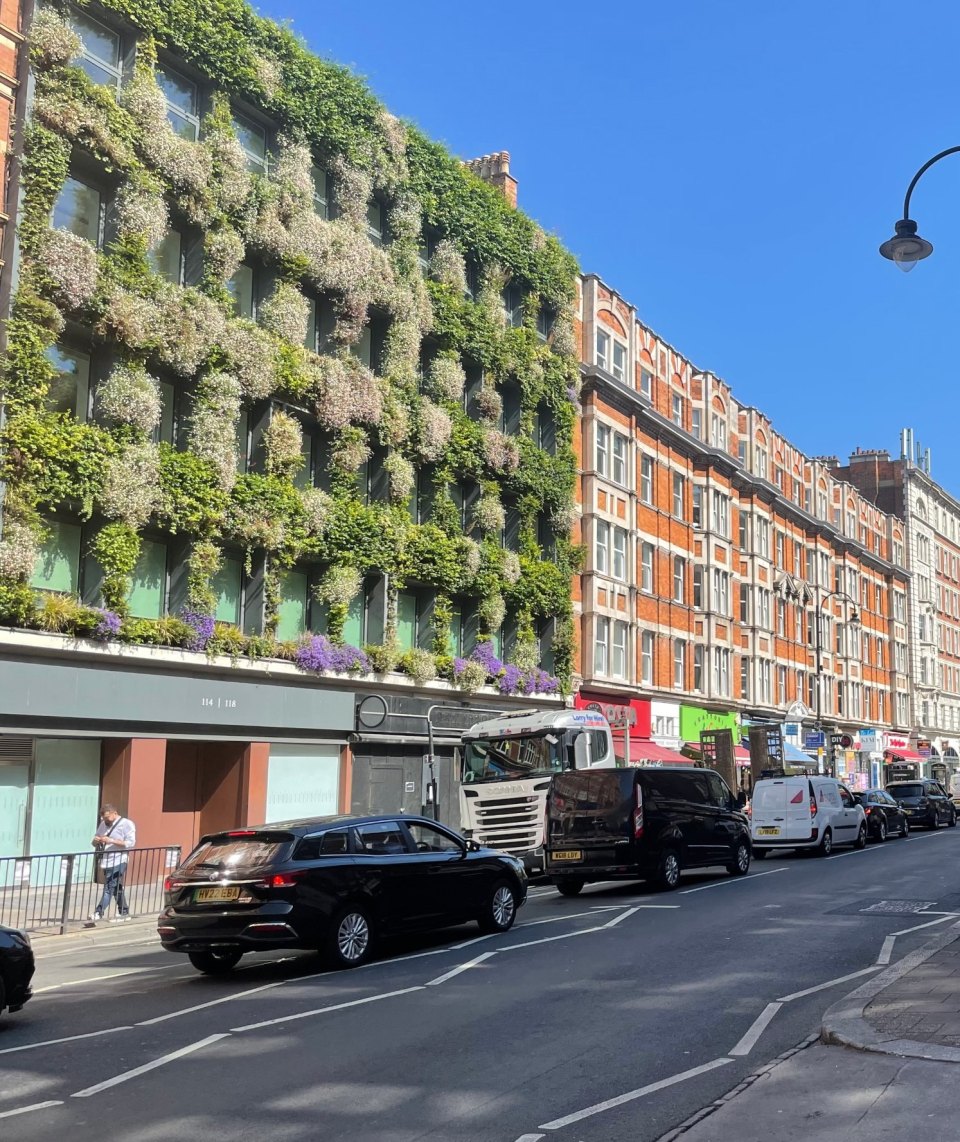
This photo on Shaftesbury Avenue shows a building whose whole facade is green. Many assume it's moss or painted wall. In fact it's a "living wall" — a vertical garden of real plants. Here it is in business terms: what it is, what it's made of, why it's done and what it costs.
Is it moss or grass?
Neither. A living wall is hundreds of live plants set into modular panels filled with nutrient substrate, fixed to a frame over the building's wall. Usually these are evergreen shrubs, ferns, perennials and ornamental grasses, sometimes with flowering plants (you can see purple flowers in the photo). Moss and lawn grass are rarely used — they hold on worse vertically and scorch faster.
How does it stay alive?
Hidden behind the greenery is an automatic irrigation system: water with nutrients is fed from the top down through tubes, usually on a timer (hydroponics). The roots sit not in ground at pavement level but in the panels themselves, so the wall stays green several storeys up. There is a cheaper option — climbers (ivy, clematis, honeysuckle) planted at the bottom — but they take years to climb.
Why do it to buildings?
Several reasons. The plants and substrate act as insulation: warmer in winter, cooler in summer through evaporation — so lower heating and air-conditioning bills. The wall absorbs some dust and noise, soaks up rainwater (less load on the drains) and shelters insects and birds. Honestly, it won't save the city from diesel fumes, but it improves the microclimate around the building.
What does it cost?
It isn't cheap. A full living wall installed in Britain averages around £500 per square metre. A small outdoor wall of 5×5 metres with an irrigation system and a year's care runs about £16,000. Plants alone are £75–112 per m², and one of the biggest costs is the irrigation. For a large facade like the one in the photo, the bill runs into hundreds of thousands of pounds.
And the upkeep?
A living wall is not "fit and forget". It needs maintenance at least four times a year: check the irrigation, prune the plants, replace the dead ones. Without servicing the wall goes patchy within a season or two and looks worse than ordinary render. That's why these facades are mostly done by companies and hotels — they have the budget for gardeners.
Where to see them in London
Living walls are not rare in London: large green facades are in Covent Garden, on offices in the City and the West End — like this one on Shaftesbury Avenue. The one called the city's largest is at The Rubens hotel in Victoria — over 21 metres tall, around 10,000 plants of 22 species, with a system that also stores rainwater for irrigation. For business it's also advertising: a green building gets noticed, photographed and remembered better than its grey neighbour.
Thanks for £1If this information was useful and came in time, press the heart. Payment goes through PayPal, with nothing to choose and nothing to fill in, and it pays for the newsroom.

- Tax Self Assessment: 31 Jan deadline
- Money Do marketplace warehouses give goods away free? The truth about unclaimed parcels
- Money Apps for renting and buying
- Life Soviet Underground: the eighties Red Wave, played live in London
- Travel Network Railcard: train discounts in South East England
- Jobs & Business Post Your Ad Free
- Law Yellow and red kerb lines: UK rules