Frankenstein by Mary Shelley — a book for the night: the opening, the author and a London trail
The most famous novel of a life created and abandoned: eighteen-year-old Mary Shelley invented it in the wet summer of 1816. The opening in the original and our translation, the author's life and a London trail — with places checked today.
Thanks for £1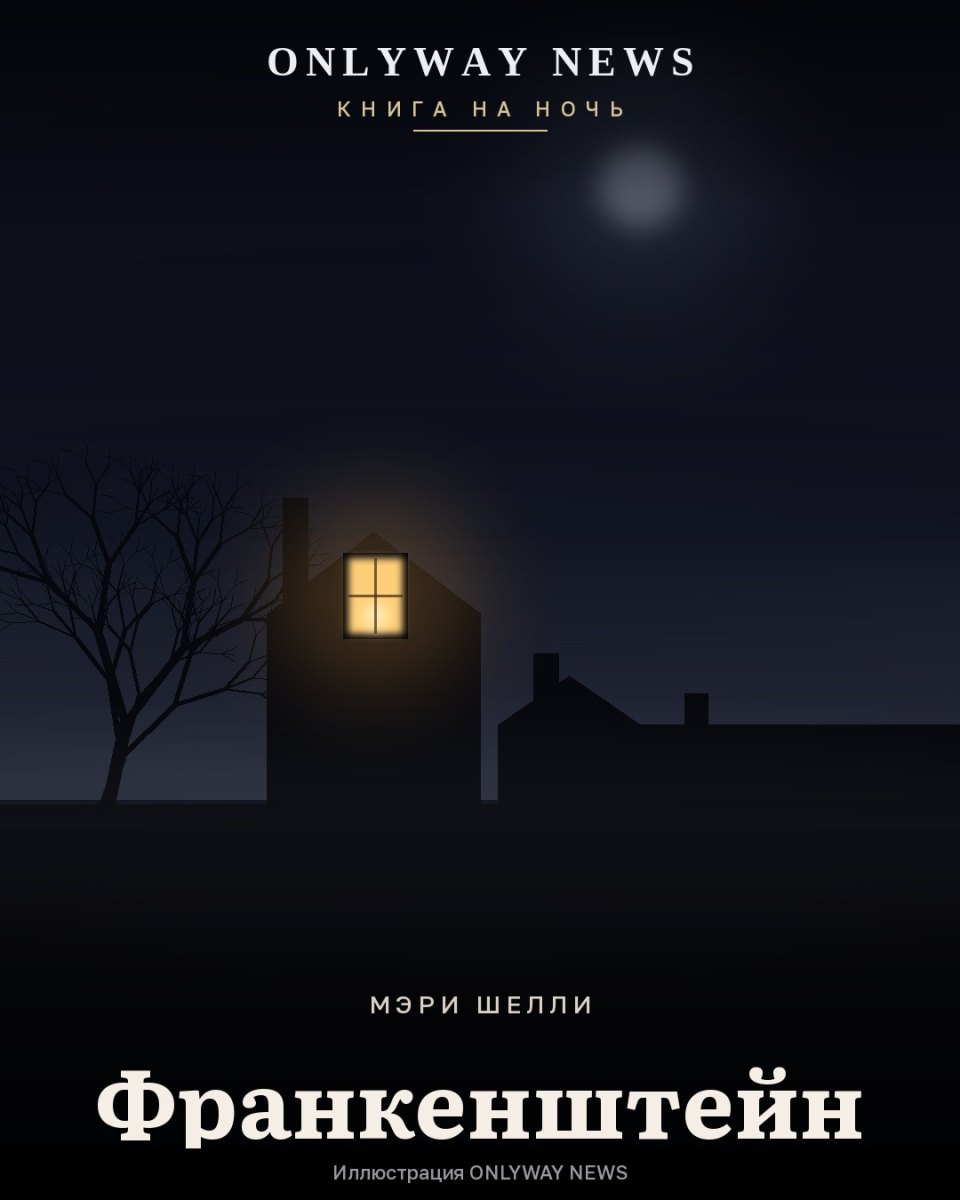
A quiet late evening is the right time to open Frankenstein. The book everyone half-knows from the films is usually pictured wrongly: not a tale of a bolt-necked monster but a sad, deeply human novel about what happens when a person makes a living being and then turns away from it. Eighteen-year-old Mary Shelley wrote it on a dare, during a wet Swiss summer in 1816, and invented something literature had not seen before — a scientist who assembles a living creature by force of knowledge, recoils from it and walks away. For a book at night it reads well because of its voice: letters and firelit confessions, unhurried. What is frightening in it is not the monster but the loneliness — of the one who is made, and of the one who made him.
The opening: how the book begins
The novel opens not in a laboratory but in a letter: a polar captain, Robert Walton, writes to his sister from a ship bound for the North Pole, and only later, out on the ice, meets the exhausted Victor Frankenstein, whose confession makes up the book. The first line:
 ONLYWAY NEWSLIVEBooks · 11.11Frankenstein by Mary Shelley — a book for the night: the opening, the author and a London trailTravel · 11.11How to renew your driving licence at 70 in the UKLife · 11.11Royal Mail: last Christmas posting dates for 2026Life · 11.11Alcohol at night and at weekends: what is actually banned in BritainLife · 11.11Free wifi on London transport: where it works and how to connectLife · 11.11Nowhere to sleep tonight: where to go and what the council owes youImmigration · 11.11Who gets status extended and settlement granted automatically — and when the passport comesLife · 11.11Makeup by Russian-speaking artists in Britain: who, where and what it costsHousing · 11.1110 reasons to move out of London — to the commuter towns or beyondLife · 11.11Scalp micropigmentation: what it costs, and why it is legally a tattooONLYWAY NEWS · appInstall the ONLYWAY NEWS appFresh UK news, classifieds, key dates and exchange rates on your home screen, one tap away. Free.NewsClassifiedsCalendarRates
“You will rejoice to hear that no disaster has accompanied the commencement of an enterprise which you have regarded with such evil forebodings.”
And here is the sentence the book is remembered for, as Victor brings his creation to life: “It was on a dreary night of November that I beheld the accomplishment of my toils… the rain pattered dismally against the panes, and my candle was nearly burnt out.” That half-extinguished light in the window is what we took for today’s illustration.
Full English text, free and lawful: Project Gutenberg, eBook #84.
Why it is worth reading today
Frankenstein looks like Gothic horror, but at heart it is a book about responsibility. Victor achieves the impossible and then has no idea what to do with the being he has made, and the whole novel lives in that failure: the creature turns dangerous not because it is born evil but because it is cast out by everyone who sees it. That is why today “a Frankenstein” means not the monster but any technology made without a thought for the consequences. The book is a story within a story — the captain’s letters, Victor’s confession and, in the middle, the voice of the creature itself, the strongest pages of all. The captain’s first letter takes about five to seven minutes aloud; the creation scene — that “night of November” — waits in chapter five. We will not give away the ending; only that it closes, again, among the ice where it began.
About the author
Mary Wollstonecraft Shelley was born on 30 August 1797 in London and died on 1 February 1851, also in London — more than seventy years ago, which is why her text is in the public domain today. Three things worth knowing. First, she was the daughter of the writer and early feminist Mary Wollstonecraft (author of A Vindication of the Rights of Woman) and the philosopher William Godwin; her mother died days after her birth, and the girl grew up reading her mother’s books at her graveside. Second, she began Frankenstein at eighteen, in the summer of 1816 by Lake Geneva, where the company — Lord Byron, the poet Percy Bysshe Shelley (her future husband) and the doctor Polidori — passed the rainy evenings inventing horror stories on a dare; the novel appeared anonymously in 1818. Third, her life was full of loss: she outlived several of her children and her husband, drowned in 1822. She is buried in Bournemouth (see below).
 ADV · A003We build websites for tradespeople and sole traders — £219Customers see your work and prices and message you straight away. Ready in 3 days, £219 instead of £438.Advertise here
A trail through her places
Mary Shelley’s chief places are in London and can be walked on foot; the grave is on the south coast, in Bournemouth. The hours and conditions below were checked today on the places’ own sites.
St Pancras Old Church, Pancras Road, London NW1 is the main point. Here Mary’s mother, Mary Wollstonecraft, was buried; at that grave the girl learned to read by the letters of her mother’s name, came here to think, and — as the story is always told — it was here that the young Mary and Percy Shelley declared their love. The church is open to visitors daily, roughly 8:45am to 4pm, entry free; around it lies the public park of St Pancras Gardens. (Wollstonecraft’s remains were later moved to Bournemouth, but the monument and the place remain.)
Somers Town, nearby. A few minutes’ walk away stood the house on The Polygon where Mary was born; it is long gone, but the short walk from the church to these streets takes you through her native London.
St Peter’s Church, Hinton Road, Bournemouth BH1. Here, in the Shelley family tomb, Mary is buried; beside her, by tradition, lies the heart of her husband Percy, together with the reinterred remains of her parents. The church is open to visitors every day, entry free; it is a day trip to the coast.
For the curious. The original manuscript, in Mary Shelley’s own hand, is kept at the Bodleian Library in Oxford and digitised online.
Where to get it
Free. The full English text is in the public domain: Project Gutenberg, eBook #84. To find the book in British libraries, use the Library Hub Discover catalogue.
Buy it in Russian. Frankenstein is a staple of the classics in Russian translation; search for «Франкенштейн» at the Russian bookshops in Britain — Notre Locus and Bookashka. Check stock and price on the shop’s site; English paperbacks are stocked by ordinary British bookshops too.
Thanks for £1If this information was useful and came in time, press the heart. Payment goes through PayPal, with nothing to choose and nothing to fill in, and it pays for the newsroom.
- Frankenstein; Or, The Modern Prometheus by Mary Wollstonecraft Shelley — Project Gutenberg (eBook #84, полный текст; первая фраза Письма 1; сцена «dreary night of November»)
- Mary Shelley — born 30 Aug 1797, died 1 Feb 1851; buried St Peter's Church, Bournemouth (londonremembers.com; findagrave #1617)
- St Pancras Old Church — opening hours (daily approx 8:45–16:00, free), parish site / A Church Near You
- St Peter's Church, Bournemouth — open every day to visitors; Mary Shelley buried in the graveyard with the heart of her husband (parish site; bournemouth.co.uk listing)
 Books
Hugh Lofting’s “The Story of Doctor Dolittle” — bedtime book: extract, author and a Maidenhead route
 Books
Gulliver’s Travels at 300: why Swift’s book is far sharper than it looks
 Books
Tess of the d’Urbervilles by Thomas Hardy — a book for the night: the opening, the author and a Dorset trail
- Travel Next-generation airport scanners in Britain: what changes and what can be searched
- Money Debt management plans in the UK: pay less, and never pay for advice
- Jobs & Business UK gender pay gap reporting: who must report and by when
- Money GBIS: free home insulation in Great Britain — who qualified
- Travel Urgent UK passport: the Premium and Fast Track services
- Life Pupil Premium: the extra funding English schools get for disadvantaged pupils
- Money How to switch energy supplier in the UK and whether it is worth it