The War of the Worlds by Wells — a book for the night: the opening, the author and a Woking trail
The editors' evening pick: The War of the Worlds by H.G. Wells (1898) — the first novel of invasion from space, set in Surrey near Woking; with the opening lines, a note on the author and a trail to the book's real places.
Thanks for £1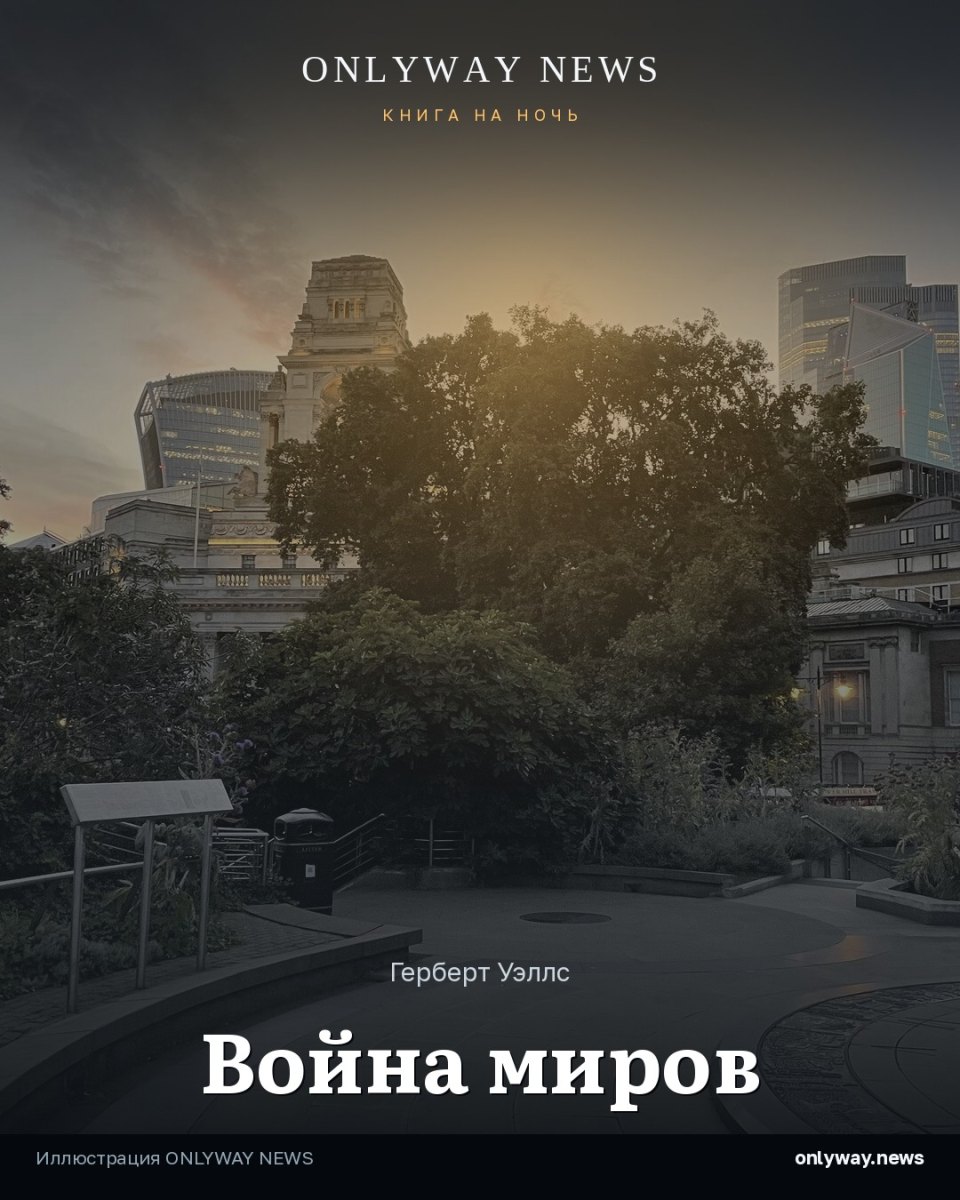
A November evening is the right time for a book that makes the quiet suburbs feel less safe. «The War of the Worlds» by H.G. Wells (1898) is the first modern novel of invasion from space, and it is set not in far galaxies but in sleepy Surrey: the Martians land on a common near Woking, twenty minutes from a London terminus, and the tidy world of commuter trains and Sunday papers collapses in a matter of days. Wells invented everything we have seen a hundred times since — the tripods, the heat-ray, millions fleeing along choked roads. But what holds the book is not the hardware; it is the cold, almost scientific eye it turns on how thin the film of ordinary order really is. Read it tonight and you’ll sleep with one ear open.
The opening lines
The novel opens with one of the most famous first sentences in science fiction: «No one would have believed in the last years of the nineteenth century that this world was being watched keenly and closely by intelligences greater than man’s…» A little further down the same first chapter comes the line the book is remembered for: «intellects vast and cool and unsympathetic, regarded this earth with envious eyes». The full English text is free and legal at Project Gutenberg, eBook #36.
 ADV · A003We build websites for tradespeople and sole traders — £219Customers see your work and prices and message you straight away. Ready in 3 days, £219 instead of £438.Advertise here
Why read it tonight
«The War of the Worlds» invented a whole genre: every invasion film since grew out of this book. But people reread it not for the tripods. Wells takes the most comfortable spot on the map — end-of-century suburban Surrey, with its train timetables and tea on the veranda — and shows, calmly and like a reporter, what happens to civilised people when they face a power that has no interest in them at all. It is a book about how quickly the polish comes off, and how small a man is beside an alien mind. The first chapter is short, about fifteen minutes: astronomers notice flashes on Mars, and the narrator does not yet know what they mean. How it ends — and why the victory comes not from guns — you should find out yourself; this is not a thing to spoil.
About the author
Herbert George Wells was born on 21 September 1866 in Bromley, near London, and died on 13 August 1946 in London — more than seventy years ago, which is why his text is now in the public domain. The son of a shopkeeper and a housemaid, he was apprenticed as a boy to a draper but broke out through education: he studied biology under Thomas Huxley, became a schoolteacher, and then the «father of science fiction». He wrote «The War of the Worlds» after moving to Woking in 1895, cycling the surrounding lanes each morning to choose exactly where the Martians would land and which streets they would burn.
Places to visit
«The War of the Worlds» is a rare case where science fiction has a precise address you can walk. All three stops are free and in the open air.
The Martian tripod (Crown Square, central Woking, Surrey). A seven-metre steel fighting machine by the sculptor Michael Condron, installed in 1998 for the book’s centenary, stands right on the town square, with a capsule «crashed» into the paving nearby. It is open-air public sculpture: free, approachable at any hour. Woking has direct trains from London Waterloo.
Horsell Common (just north of Woking) is the very heath where the first cylinder falls in the novel; Wells described its sandpit almost to the letter. It is open common land: free to enter, walked all year round.
 ONLYWAY NEWSLIVETravel · 02.11Passenger Assist: free help at the station and on the trainLaw · 02.11Fireworks in Britain: the law, times, age and fines 2026Markets · 02.11UK fuel prices: petrol 172.1p, diesel 198.7p — weekly reviewMarkets · 02.11UK launches £700m programme for major industrial sitesTravel · 02.11Zip Oyster photocard: free and discounted travel for children in LondonLife · 02.11Support for veterans in Britain: card, compensation and helpLife · 02.11Public rights of way: where you can walk in the UKHousing · 02.11A listed home in England: what you cannot change without consentLife · 02.11Charity clothing collections: how to donate safelyHousing · 02.11Can you cut down a tree at your home in England? TPO rules and finesONLYWAY NEWS · appInstall the ONLYWAY NEWS appFresh UK news, classifieds, key dates and exchange rates on your home screen, one tap away. Free.NewsClassifiedsCalendarRates
Primrose Hill (north London) is the hill where, at the close, the narrator finds the Martians. A Royal Park, free to enter; from the top there is an open view over the whole city — the same view that lies before the hero, hushed and spared, in the final chapters.
Where to get it
Free. The full English text is in the public domain: Project Gutenberg, eBook #36. To find it in British libraries, use the Library Hub Discover catalogue.
Buy in Russian. Wells’s «The War of the Worlds» is a staple classic; search for «Война миров» at the Russian bookshops in Britain — Notre Locus and Bookashka. We don’t pin stock or price here — check the shop’s site; an English paperback is carried by ordinary British bookshops too.
Thanks for £1If this information was useful and came in time, press the heart. Payment goes through PayPal, with nothing to choose and nothing to fill in, and it pays for the newsroom.
- The War of the Worlds by H. G. Wells — Project Gutenberg (eBook #36, полный текст, общественное достояние)
- The War of the Worlds — Wikipedia (1897 сериал / 1898 книга, Уокинг и Хорселл-Коммон, Уэллс переехал в 1895)
- H. G. Wells — Wikipedia (годы жизни 1866–1946, биография)
- Woking's Martian tripod — Celebrate Woking (Crown Square, Майкл Кондрон, 1998, проверено 02.11.2026)
- Library Hub Discover — каталог фондов британских библиотек
- Life Russian-speaking doctors and clinics in London: eight addresses checked against the registers
- Jobs & Business Post Your Ad Free
- Life Russian-language events in London: verified dates to December 2026
- Travel Peak and off-peak fares in London 2026: when travel is cheaper
- Money Energy bills: 40% still struggle to pay — what households can do
- Money The Autumn Budget lands on 28 October: what is already confirmed
- Housing Can you cut down a tree at your home in England? TPO rules and fines