The King of the Golden River by John Ruskin — a book for the night: excerpt, author and a Ruskin trail
John Ruskin's only fairy tale — a “legend of Stiria” about Treasure Valley, three brothers and the King of the Golden River, where everything turns on a kind heart. The opening line in the original and our translation, the author, and a trail through Ruskin's places.
Thanks for £1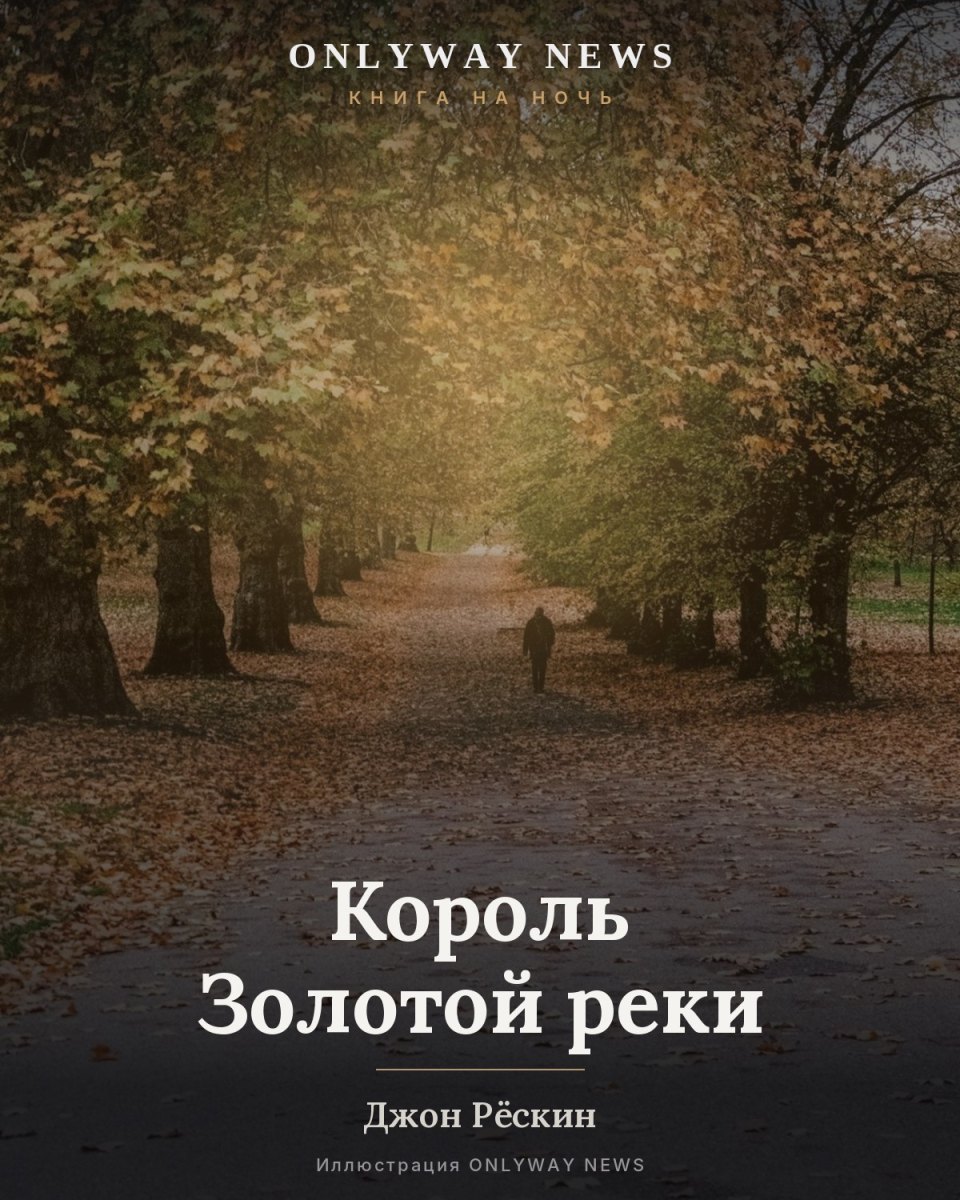
The King of the Golden River is the only fairy tale John Ruskin ever wrote — and he was the greatest art critic of the Victorian age. He wrote it in 1841 for twelve-year-old Effie Gray, the girl he would later marry, and published it only in 1851. It is a “legend of Stiria”: high in the mountains of Styria lies Treasure Valley, a place of astonishing fertility owned by three brothers. The two elder ones, Hans and Schwartz, are cruel and greedy; the youngest, kind twelve-year-old Gluck, is gentle to every living thing. One stormy night a strange little guest knocks at their door — Southwest Wind, Esquire — and from then on the fate of the valley, and of the brothers themselves, turns on who has a heart and who has a stone. Short, warm and free of preachiness — exactly one quiet evening.
The excerpt: how the book begins
The tale opens with a calm, almost lullaby line that leads us into the enchanted valley:
 ADV · A001ONLYWAY JEWELRY — gold, silver and platinumRings, chains, bracelets, earrings and pendants. Delivery across the UK.Advertise here
“In a secluded and mountainous part of Stiria there was, in old time, a valley of the most surprising and luxuriant fertility.”
In our translation: “В уединённом горном уголке Штирии была некогда долина поразительного, пышного плодородия.”
Translation by ONLYWAY NEWS from the original published on Project Gutenberg.
And then the hook that tells you the whole story. In a thunderstorm a tiny man calling himself “Southwest Wind, Esquire” knocks at the brothers’ door — and the way he is received decides whether Treasure Valley stays green or withers to dust. Full English text — Project Gutenberg, eBook #701.
Why read it tonight
This is a fairy tale about greed and kindness, written by a man who spent his life arguing that beauty and wealth are not the same thing. Ruskin never lectures: he simply shows what is won with a stone heart and what with a warm one, and gives each brother a single chance. We won’t spoil the ending — it earns its keep. The tale is short, in five parts; the first part, where we meet the brothers and Treasure Valley, reads aloud in about ten minutes — just right for a child drifting off, or one unhurried grown-up evening.
About the author
John Ruskin was born on 8 February 1819 in London (54 Hunter Street, by Brunswick Square, Bloomsbury) and died on 20 January 1900 at Brantwood, his house above Coniston Water. Three things worth knowing. First, he was the leading art critic of his century: his multi-volume Modern Painters began as a defence of the landscape painter J. M. W. Turner and grew into a whole doctrine of truth in art and Gothic architecture. Second, in 1869 he became Oxford’s first Slade Professor of Fine Art, but resigned in 1879 after losing a libel case to the painter James McNeill Whistler, whom he had savaged in print. Third, he spent his inherited fortune on social schemes — founding the Guild of St George, with workshops and schools for working people. The King of the Golden River remained his only work of fiction — a fairy tale written for the girl who would become his wife.
 ADV · A003We build websites for tradespeople and sole traders — £219Customers see your work and prices and message you straight away. Ready in 3 days, £219 instead of £438.Advertise here
Places to visit
Ruskin Park, Denmark Hill, London SE5 8EL. This south-London park is named after Ruskin and laid out on land beside the houses where he spent his boyhood (Herne Hill and Denmark Hill). Open daily from 7am, closing 15 minutes before sunset; free entry, run by Lambeth Council. A quiet green walk in the very spirit of the tale’s fertile valley.
The Ruskin Collection, Millennium Gallery, Arundel Gate, Sheffield S1 2PP. The collection Ruskin founded for his Guild of St George, so that working people could see the best of art and nature — drawings, minerals, casts. Open Tue–Sat 10am–5pm and Sun 11am–4pm, closed Mondays; free entry (a £5 donation is suggested). Run by Sheffield Museums.
Brantwood, East of Lake, Coniston, Cumbria LA21 8AD. The house where Ruskin spent his last years and died, above Coniston Water, looking out on mountains much like the ones he wrote about. In winter it opens Wednesday to Sunday: house 10:30am–3pm, gardens to 3:30pm. Tickets (house and gardens) — adult £16.50, student £13.75, children under 16 free; the ticket doubles as an annual pass. A few winter weeks are closed for maintenance, so check the website before travelling.
Where to find it
Free. The full English text is on Project Gutenberg (eBook #701), legally and in the public domain: Ruskin died in 1900. For a printed copy in your nearest library, search Library Hub Discover, which brings together the holdings of British libraries.
Buy. In English the tale is easy to find at Blackwell’s and any large bookshop. In Russian it has appeared in collections of English literary fairy tales and is rarely printed on its own; at Britain’s Russian bookshops — Pushkin House Bookshop (Bloomsbury), Notre Locus and Bookashka — it is worth asking for or ordering, and if a given edition is out of stock, look for a collection containing the tale through the same library catalogue.
Thanks for £1If this information was useful and came in time, press the heart. Payment goes through PayPal, with nothing to choose and nothing to fill in, and it pays for the newsroom.
- The King of the Golden River by John Ruskin — Project Gutenberg, eBook #701 (полный текст; первая фраза)
- The King of the Golden River — Encyclopaedia / Wikipedia (сюжет, Штирия, Сокровищная долина, год написания 1841 и издания 1851)
- John Ruskin — Encyclopaedia Britannica (годы жизни, «Современные художники», первый Слейдовский профессор, иск Уистлера)
- Brantwood — Visit (часы работы и цены билетов, проверено 18.11.2026)
- Millennium Gallery, Sheffield Museums — Ruskin Collection (часы работы, бесплатный вход, проверено 18.11.2026)
- Friends of Ruskin Park — Visit (часы работы парка, адрес SE5 8EL, проверено 18.11.2026)
 Books
The Forsyte Saga by John Galsworthy — a book for the night: excerpt, author and a London trail
 Books
George MacDonald’s At the Back of the North Wind — bedtime book: the opening, the author and a London trail
 Books
Thackeray’s Vanity Fair — bedtime book: the opening, the author and a London trail
- Jobs & Business Post Your Ad Free
- Jobs & Business A ‘free office’ in London? Where you are welcome, with Wi-Fi and tea
- Life Nemnogo Nervno’s Kateryna Gopenko plays London on 20 November
- Books Book at bedtime: Pride and Prejudice and the price of a good match
- Money £1 houses and money for moving north: what is actually true
- Life A provisional licence in the UK: £34 online, £43 by post, three conditions
- Life Russian-speaking doctors and clinics in London: eight addresses checked against the registers