A new sculpture on Trafalgar Square: Tschabalala Self’s Lady in Blue
Unveiled on the Fourth Plinth on 10 September — a bronze figure of a young Londoner, patinated lapis lazuli blue. What the plinth is, why it stood empty for a century and a half, what was there before, and how to see it for free.
Thanks for £1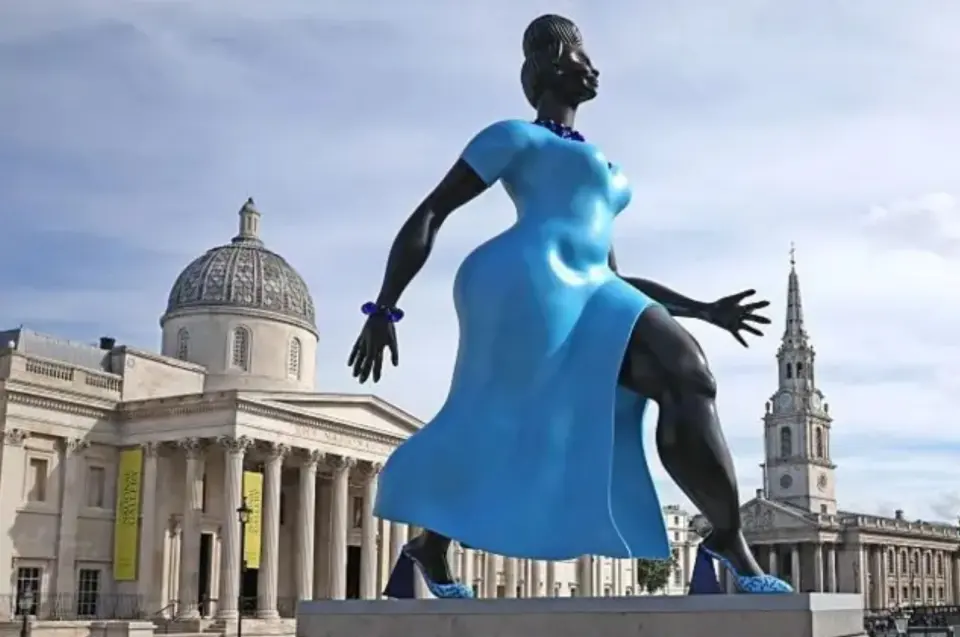
A new sculpture was unveiled on the Fourth Plinth in Trafalgar Square on 10 September: Lady in Blue by the American artist Tschabalala Self. It is free to see at any hour — the square never closes.
What is up there now?
A bronze figure of a young woman caught mid-stride. The bronze is patinated a deep lapis lazuli blue, which gives the work its name. Head, arms and legs are left dark while the dress is bright blue; from a distance the figure looks dressed in actual cloth.
The artist describes her as an everywoman — someone in whom a great many people can recognise somebody. In her words this is a Londoner walking forward with intent and purpose, and that is the spirit of the city.
London's deputy mayor for culture, Justine Simons, called the work a bold contemporary statement and noted that a confident young woman will make a striking addition to this historic part of the city.
Tschabalala Self was born and works in New York and is known for painting and collage dealing with the body, the female figure and African-American identity. The Fourth Plinth is her first major public sculpture in Britain.
Why is the plinth empty in the first place?
The story explains half the charm of the place. The plinth in the north-west corner of the square was built in 1841 for an equestrian statue of King William IV. The money for the statue was never raised — and it stood empty for over a century and a half.
In 1998 it began hosting temporary contemporary art, and since 2005 the programme has been run by the Mayor of London. The Fourth Plinth has become the country's leading platform for public art: every couple of years one work replaces another, and every one of them starts an argument.
 ADV · A003We build websites for tradespeople and sole traders — £219Customers see your work and prices and message you straight away. Ready in 3 days, £219 instead of £438.Advertise here
The previous occupant was Mil Veces un Instante by the Mexican artist Teresa Margolles — 850 plaster casts of the faces of trans people and women, stacked in the manner of a tzompantli, the Aztec skull rack. In 2028 Lady in Blue will be replaced by a work from Andra Ursuţa.
How can you see it?
Trafalgar Square, north-west corner. Nearest tube is Charing Cross (Northern and Bakerloo), with Leicester Square and Embankment close by. Entry is free, the sculpture stands in the open air, and there are no opening hours.
While you are there: the National Gallery is directly behind the plinth, entry to the permanent collection is free, and it is one of the best places in London to step into for twenty minutes on your way somewhere. Next door, St Martin-in-the-Fields runs free lunchtime concerts and has a café in the crypt.
The best light for a photograph is towards evening, when the sun drops behind the National Gallery and the blue dress stops throwing glare.
Read next: What to do in London on 12–14 September: Open House, the… · London on Sunday 13 September: what is free and what you pay…
Thanks for £1If this information was useful and came in time, press the heart. Payment goes through PayPal, with nothing to choose and nothing to fill in, and it pays for the newsroom.

- Housing Drought: minister lets the Agency take more water to avoid rota cuts
- Travel Jubilee line part suspended to Stanmore after fire alert
- Life A London concert cancelled back in March is still on sale for 4 October — and the full Russian-language listings for October
- Life Russian-language events in London: verified dates to December 2026
- Travel London Tube and TfL closures in October 2026: the Piccadilly line stops entirely at Halloween, and no Tube to Heathrow on 17–18 October
- Jobs & Business From 1 October, right to work checks reach couriers, subcontractors and platform workers
- Money Section 75 and chargeback: how to get your money back in the UK