Unit pricing on shelf labels: what changed and how not to overpay
Since 6 April 2026 a unit price must be shown for loyalty-card prices and promotions too, and labels priced per 100g are no longer a lawful form. Here is where unit prices may lawfully be missing, and why the bigger pack is not always cheaper.
Thanks for £1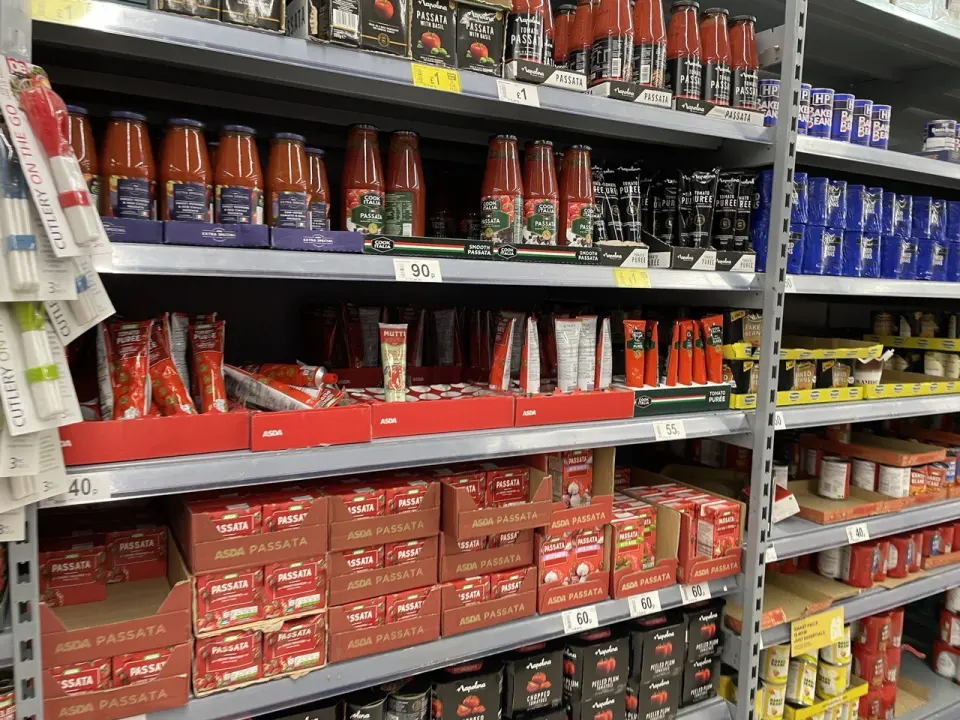
The small line under the price — the cost per kilogram, litre or item — is the only honest way to compare products. From 6 April 2026 the rules on showing it changed, in the shopper's favour.
What changed
First, the units were standardised. The same product could previously be priced per 100g on one label and per kilogram on another. A unit price is now expressed only per kilogram, litre, metre, square metre or cubic metre — or per item where goods are sold by number. A label priced per 100g is no longer a lawful unit price.
Second, and more significant: where a product carries more than one selling price, each must be shown. A new article 7A requires the trader to display every selling price and every corresponding unit price, together with the condition on which the lower price depends — prominently and in close proximity to the product.
That closes the loyalty-card loophole. The government guidance works through the example: an item at £2 for everyone and £1 with a loyalty card must show both selling prices, both unit prices and the condition. Giving one set of prices prominence over the other is not allowed.
The same applies to offers such as two for £7: unless the deal falls within an exemption, the promotional unit price must be shown.
Where a unit price may lawfully be missing
The exemptions survive, and they are worth knowing before you argue at the till.
Small shops. Where the relevant floor area is no more than 280 square metres, pre-packed goods in constant quantities may be sold without a unit price. Goods sold from bulk are not covered: fruit, vegetables, meat, fish and cheese from a counter must carry a price per kilogram even in the smallest shop.
 ADV · A003We build websites for tradespeople and sole traders — £219Customers see your work and prices and message you straight away. Ready in 3 days, £219 instead of £438.Advertise here
Other cases: goods reduced because they are damaged or near their date; items where the unit price equals the selling price, such as a one-litre pack; assortments such as a fixed-price dinner deal; and prices that round to zero.
Why this is real money
The Competition and Markets Authority analysed a basket of 26 everyday products and found the usual rules of thumb unreliable.
Larger packs are usually cheaper per unit, but not always: toilet roll, cheese and laundry capsules were among the exceptions. Promotional lines are often the cheapest per unit, yet some ketchup and laundry liquid offers worked out dearer per unit than other pack sizes.
The size of the saving varies wildly. A four-pint bottle of milk was nearly 60% cheaper per unit than a single pint. Standard tins of baked beans and chopped tomatoes were 45–50% cheaper per unit than small tins. Washing-up liquid in the largest bottle saved only about 5%.
Labels get it wrong more often than you would think
Scottish Trading Standards found unit-pricing problems on 6.5% of supermarket items checked: 43% of those had no unit price at all and 57% had an incorrect one. Variety stores were worse — the CMA recorded a 250ml hand wash at £1.19 labelled at “£476.00 per 100ml”.
Where to complain
Enforcement sits with local Trading Standards, the only body that can bring a prosecution. Shoppers do not approach it directly: complaints go through the Citizens Advice consumer service on 0808 223 1133, or Advice Direct Scotland on 0808 164 6000 in Scotland. Government guidance describes the fine for breaching the order as unlimited, and since 2024 regulators have also been able to seek redress for consumers and penalties against businesses.
What the law does not require
One honest caveat: the price marking rules contain no duty to sell at a mistaken shelf price. A wrong label is a breach for Trading Standards to pursue, but it does not automatically entitle you to buy at that price.
What to do
Read the bottom line of the label, not the big figure. Compare like with like — easier now that the units are standardised. Check whether a unit price is shown against the loyalty price: if it is missing, that is a breach. And re-check the few items you buy on autopilot, because that is where the money quietly goes.
Thanks for £1If this information was useful and came in time, press the heart. Payment goes through PayPal, with nothing to choose and nothing to fill in, and it pays for the newsroom.

- Jobs & Business Post Your Ad Free
- Life Russian-speaking doctors and clinics in London: eight addresses checked against the registers
- Life Russian-language events in London: verified dates to December 2026
- Travel London Tube and TfL closures in October 2026: the Piccadilly line stops entirely at Halloween, and no Tube to Heathrow on 17–18 October
- Life See London from above for free: four viewpoints and their entry rules