Eight UK Robotics Adoption Hubs Launch with £40 Million
Hospitals, farms and companies will be able to test robots before investing and get independent help with deployment. Separate funding will support training and robotics skills.
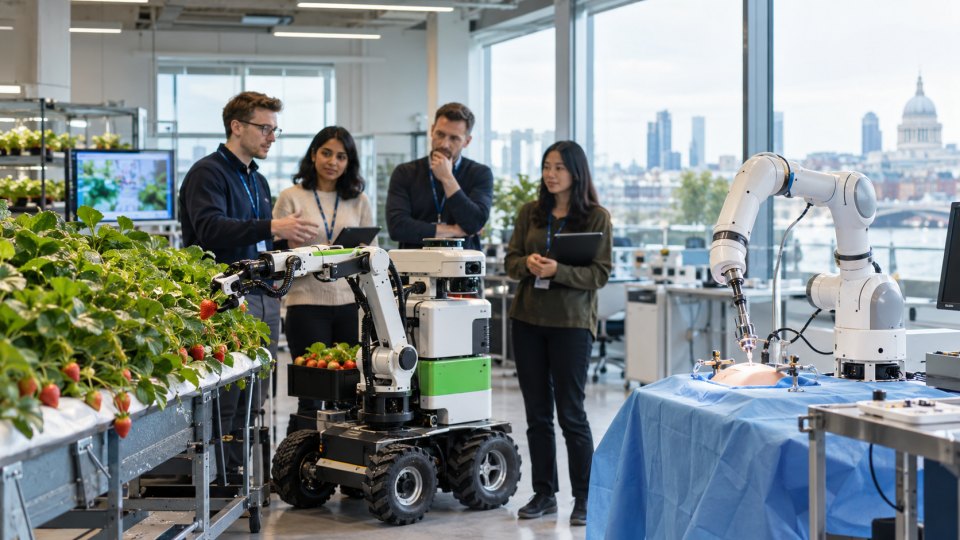
A network of eight Robotics Adoption Hubs has started operating across the UK, backed by £40 million of government funding announced on 9 October. These are not laboratories focused only on distant prototypes. They are intended to help hospitals, farms, manufacturers, logistics operators and recycling businesses see proven systems in action, test them before buying and get practical deployment support.
What will the surgical robotics hub do?
SHARP, the National Surgical Robotic Adoption Hub, will support the safe and evidence-based rollout of robotic surgery. The systems are designed to assist with less invasive procedures, which can mean smaller incisions, faster recovery and an earlier return home. The announcement does not guarantee robotic surgery to every NHS patient; the hub will help healthcare organisations assess the technology and implement it safely.
 ADV · A001ONLYWAY JEWELRY — gold, silver and platinumRings, chains, bracelets, earrings and pendants. Delivery across the UK.Advertise here
How will farmers benefit?
The HARVEST hub in Lincoln will focus on agriculture and food production, with testbeds covering arable farming, fruit, vegetables and food manufacturing. The examples include automated fruit-picking machines that could complete harvests faster and free workers for other tasks. The programme is also meant to help businesses understand costs, workforce requirements and the practical limits of each system.
Which other sectors are included?
The eight hubs cover different regions and industries. Milton Keynes will work on service robots, drones and self-driving vehicles for public spaces, transport, logistics and delivery. A national waste and recycling hub will help sites test robots that recover more material and reduce landfill. Hubs in Yorkshire and South Wales will support manufacturing, while the Greater South West and Welsh programmes will offer demonstrations, feasibility work and investment advice.
Can an organisation test a robot before buying?
Yes. A “test before invest” approach is central to the programme. Organisations will be offered impartial advice on benefits, costs and technical requirements, real-world demonstrations, and links to suppliers, integrators and finance providers. The target users are businesses and public services that want to deploy existing technology but do not know how to choose or introduce it.
Will staff receive training?
A separate £2.5 million supports 12 skills projects. They range from robotic inspection, port logistics and autonomous maritime systems to industrial robot arms and school programmes. The list includes a study for a robotics technician apprenticeship and practical courses for engineers who will specify, install, operate and maintain equipment.
How will the hubs work together?
A further £1.7 million funds AURA, a coordinating body delivered by The Welding Institute and Anglia Ruskin University. Its job is to connect the hubs, share evidence and stop each region having to solve the same adoption problems from scratch.
What economic impact is expected?
The government release cites an estimate that robotics and autonomous systems could add £150 billion to the UK economy by 2035 if adoption is maximised. At the current level of adoption, the estimate is only £6.4 billion. These are projections rather than money already generated; success will depend on how many organisations move from demonstrations to working deployments.
For patients and consumers, the announcement does not create an immediate new service. The practical effect should appear through hospitals, employers and local services that use the hubs, train staff and introduce equipment safely.



- Travel Windrush line delays and Croydon tram closures: London tube today, 5 October
- Money UK sanctions Cryptomus, Heleket and VexPay: what it means for money transfers
- Markets Diesel passes £2 a litre for the first time: what it costs in London today and where to fill up cheaper
- Money Your gas and electricity debt can be written off in full: who Ofgem is clearing 2022–2024 bills for, and what you must do
- Life MenB jab for students: free until 31 December, but only 27% have had a first dose
- Housing Damp and mould in a rented flat: strict repair deadlines are coming to private landlords
- Law A jury summons has arrived: what to do, how long it lasts and what it pays