Graffiti fines and the Banksy paradox
A tag means a fine and court; a Banksy is guarded and sold. Why others can’t and he seemingly can.
Thanks for £1
On one wall a teenager sprays their tag — and risks a fine and a criminal record. On the next a Banksy appears — and it is covered with glass, guarded and sold for millions. The law is supposedly the same for all, yet the outcome is opposite. Here is what Britain punishes, and why Banksy seems to get away with it.
How big is the graffiti fine?
The quick penalty is an on-the-spot fixed penalty notice of around £80, issued by the council or police. If the case goes to court, the fine rises to £2,500, and serious damage can bring a prison sentence. A separate cost is cleaning: removing paint from a wall is expensive, and the bill is often handed to the offender.
 ONLYWAY NEWSLIVEUK & Politics · 23.11Graffiti fines and the Banksy paradoxTechnology · 23.11A robot decided? Your rightsMoney · 23.11Why not London: where is cheaperLife · 23.11Scotland is not England: howLife · 23.11Leicester Square: a quick guideMoney · 23.11Faulty goods: your refund rightsTravel · 23.11Flight delay: £220–£520Housing · 23.11The Decent Homes StandardMoney · 23.11Section 75: card protectionMoney · 23.11Pension Credit: mixed-age couplesONLYWAY NEWS · appInstall the ONLYWAY NEWS appFresh UK news, classifieds, key dates and exchange rates on your home screen, one tap away. Free.NewsClassifiedsCalendarRates
Is it actually a crime?
Yes. Unauthorised graffiti in Britain is criminal damage: a drawing on someone else's wall without the owner's consent falls under the Criminal Damage Act 1971. Where the damage exceeds £5,000 the law in principle allows up to ten years in prison — in practice such severity is rare, but formally graffiti sits alongside damaging someone's property, not alongside "art".
So why is Banksy allowed?
People often say: "he is anonymous, there is no one to prosecute." That is only half true. Banksy is hardly an invisible man: his company Pest Control authenticates his works and handles his copyright, he goes to court over the use of his images, and in 2019 he opened his own shop, Gross Domestic Product. A whole industry has grown around the name — galleries, exhibitions, merchandise. And still he is not tried for damaging walls. There are three reasons.
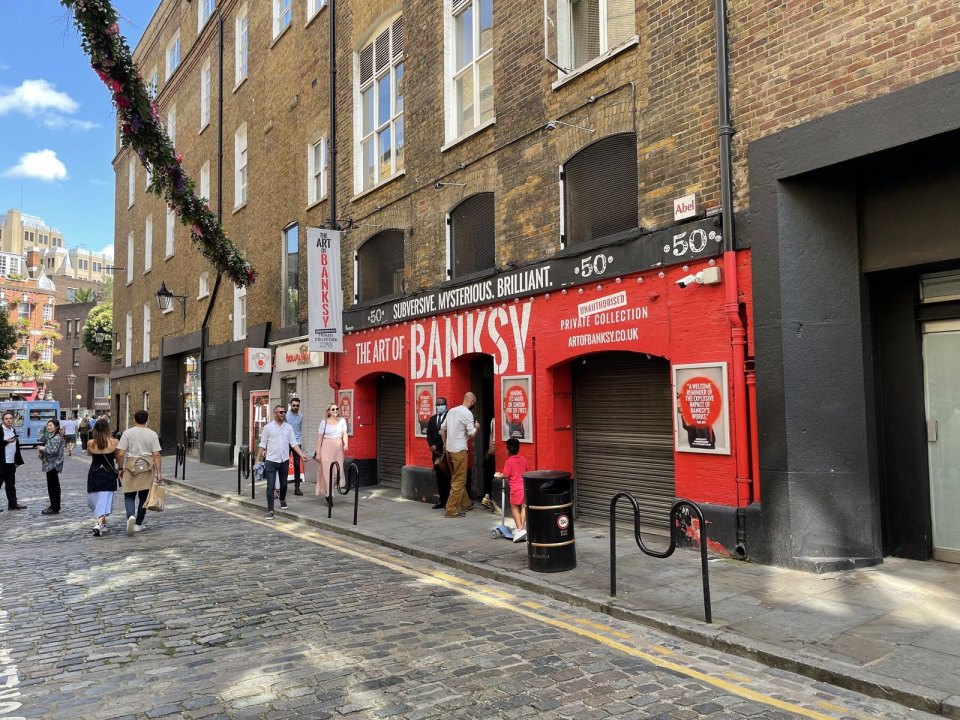
First, there is no one to file a complaint. Criminal damage is in practice investigated when the owner reports it. A Banksy turns a wall into a landmark: the owner does not scrub it off but screens it with glass, guards it or sells it with a chunk of brickwork. No victim, no case.
Second, commerce and copyright sit apart from the criminal offence. Banksy defends the rights to his images through a buffer company without naming the physical person. You can own a brand and sue over a picture anonymously — but that is a dispute about an image, not an admission that a specific man held the can that night.
Third, it is almost impossible to prove. To convict for criminal damage you must show that a specific person made a specific drawing. Banksy has never been caught in the act, and his identity has never been established in court — tellingly, in 2020 the EU cancelled his trademark, reasoning partly that the artist "cannot be identified" for certain. The very anonymity that weakens his brand protection is what shields him from prosecution.
And whose work is it, on someone else's wall?
Legally, the wall owner's. It is they who decide the drawing's fate: paint over, keep, remove and sell. The artist can object to their work being distorted, but not to the owner removing it. So the fate of a street piece depends not on the artist but on who owns the brick under the paint.
Where is the line between vandalism and art?
The line is simple and non-legal: permission and value. A mural agreed with the building's owner and the local community is legal street art, of the kind Bristol (Banksy's home town, covered in our city guide) and London's Shoreditch are famous for. The same can on someone else's wall without asking is a crime. For an artist the lesson is practical: if you want to paint the street legally, find a wall where you are allowed, not one where you'll be caught.
Thanks for £1If this information was useful and came in time, press the heart. Payment goes through PayPal, with nothing to choose and nothing to fill in, and it pays for the newsroom.
- Life Nemnogo Nervno’s Kateryna Gopenko plays London on 20 November
- Money Do marketplace warehouses give goods away free? The truth about unclaimed parcels
- Life Russian-speaking doctors and clinics in London: eight addresses checked against the registers
- Books Book at bedtime: Pride and Prejudice and the price of a good match
- Immigration UK Standard Visitor Visa in 2026: Rules, Fees and Duration
- Jobs & Business Post Your Ad Free
- Jobs & Business A ‘free office’ in London? Where you are welcome, with Wi-Fi and tea