Moll Flanders: a bedtime book
An extract from Defoe's novel and a walk through its London places.
Thanks for £1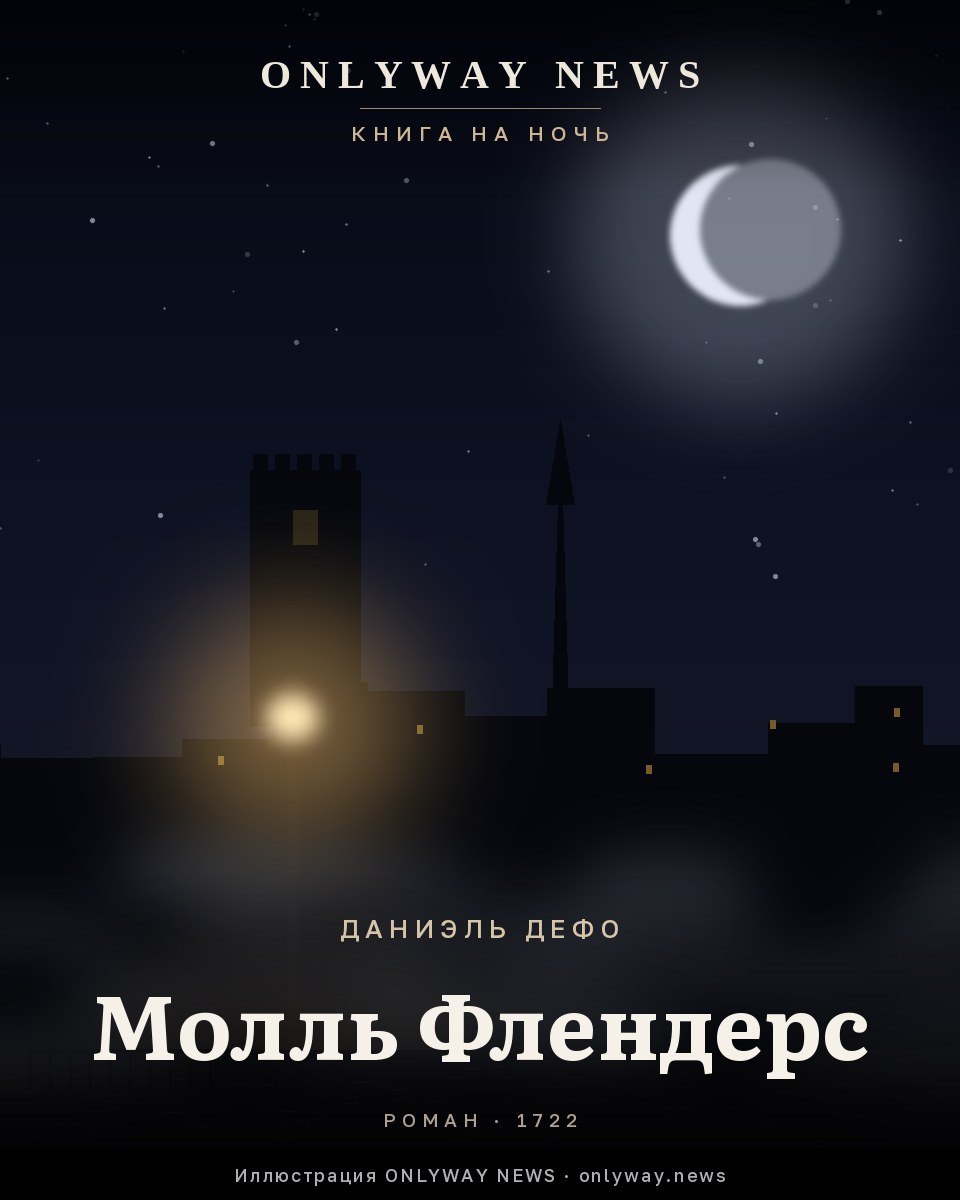
Moll Flanders (1722) is one of the first long stories the English novel ever told in the first person — and it is told by a woman. Daniel Defoe handed the pen to his heroine: born in Newgate Prison, twelve years a thief, five times a wife, transported to Virginia and, in old age, grown rich and penitent. It is neither a sermon nor a catalogue of vices, but the living, businesslike, often wry voice of someone who counted every shilling and every danger all her life. The reason to open it tonight is that voice — and the London it shows from the inside: markets, lodgings, Newgate and the Old Bailey. An evening with Moll is an evening in the old city, seen by the woman it both fed and nearly ruined.
The opening line
The book begins with the narrator admitting she cannot give her real name:
«My true name is so well known in the records or registers at Newgate, and in the Old Bailey, and there are some things of such consequence still depending there, relating to my particular conduct, that it is not be expected I should set my name or the account of my family to this work.»
 ADV · A001ONLYWAY JEWELRY — gold, silver and platinumRings, chains, bracelets, earrings and pendants. Delivery across the UK.Advertise here
So two addresses appear in the very first sentence — Newgate and the Old Bailey — and both can still be walked to. The full text in the public domain is at Project Gutenberg (eBook №370).
Why read it today
This is a novel about survival, not sin. Moll tells her life the way she might keep an account book: what a marriage cost, what an arrest cost, what it took to start again across the ocean. Behind that plainness is a rare eighteenth-century attempt to listen to a woman with no name, no family and no money, who gets back on her feet every time. Defoe neither condemns nor excuses her; he lets her speak. We leave the ending alone. The opening pages — her birth in Newgate and her orphaned childhood in Colchester, where little Moll stubbornly wants to be a 'gentlewoman' — take about fifteen minutes, and after that the book has you.
About the author
Daniel Defoe (c. 1660, Fore Street in the City of London — 24 April 1731, London) was born plain Daniel Foe and later added the grander 'De'. He was far more than a novelist: a merchant, pamphleteer, journalist and even a government agent. In July 1703 he was placed in the pillory for his satirical pamphlet 'The Shortest-Way with the Dissenters' — and, by legend, the crowd pelted him with flowers rather than stones. He wrote Robinson Crusoe at around sixty, in 1719; Moll Flanders followed three years later. Defoe is buried at Bunhill Fields in the City — the last stop on our walk.
A walk through the places
The Old Bailey, Central Criminal Court (Old Bailey, EC4M 7EH). On this very spot, where Newgate Prison once stood, Moll is 'born' in the first line. The public galleries are open to visitors roughly 9:30am–3:30pm (the building itself runs 8am–7pm). Entry is free, but you may not bring in large bags or any electronic devices, phones included, and there is no cloakroom at the door. Tube: St Paul's.
St Sepulchre-without-Newgate (Holy Sepulchre London, Holborn Viaduct, EC1A). The old church directly opposite former Newgate still keeps the handbell that was rung outside the condemned cells the night before an execution. Entry is free; weekday hours vary — Monday 11am–3pm, Tuesday and Thursday 8:30am–2:30pm, Wednesday 8:30am–6:30pm, Friday 10am–4pm, Sunday 10:30am–4pm (Saturday by arrangement, office@hsl.church). Tube: St Paul's or Farringdon.
Bunhill Fields Burial Ground (entrances on City Road and Bunhill Row). A stone obelisk marks Defoe's grave in the old nonconformist burial ground, which took burials as far back as the Great Plague. John Bunyan, William Blake and Isaac Watts lie nearby. Open weekdays from 7:30am, weekends from 9:30am, until 7pm or dusk — whichever is earlier; free. Tube: Old Street or Moorgate.
Where to find it
Free. The full English text is at Project Gutenberg (eBook №370); to see which British libraries hold it, use Library Hub Discover. Buy. The English edition is at Blackwell's; a Russian translation of Moll Flanders can be found at London's Russian bookshops Pushkin House Bookshop, Notre Locus and Bookashka (in stock or to order).
Thanks for £1If this information was useful and came in time, press the heart. Payment goes through PayPal, with nothing to choose and nothing to fill in, and it pays for the newsroom.
- The Fortunes and Misfortunes of the Famous Moll Flanders — Project Gutenberg, eBook №370 (full text; the novel's opening sentence)
- Daniel Defoe — Wikipedia (b. c. 1660 Fore Street, d. 24 Apr 1731; buried Bunhill Fields; pillory 31 Jul 1703 for 'The Shortest-Way with the Dissenters'; Robinson Crusoe 1719, Moll Flanders 1722)
- Bunhill Fields Burial Ground — City of London (Defoe's resting place; weekdays from 7:30, weekends from 9:30, to 7pm or dusk; free)
- Central Criminal Court (Old Bailey) — GOV.UK Find a Court (Old Bailey EC4M 7EH; public access 9:30–15:30; no large bags or electronic devices)
- Holy Sepulchre London (St Sepulchre-without-Newgate), Holborn Viaduct EC1A — opening times and contact

- Tax Self Assessment: 31 Jan deadline
- Money Do marketplace warehouses give goods away free? The truth about unclaimed parcels
- Law Yellow and red kerb lines: UK rules
- Travel Next-generation airport scanners in Britain: what changes and what can be searched
- Life Free English with a native speaker: how Russian speakers can find a language partner
- Travel Red lines on London roads
- Life Where you can legally marry in England