Through the Looking-Glass: book
An extract from Carroll and a walk through its London places.
Thanks for £1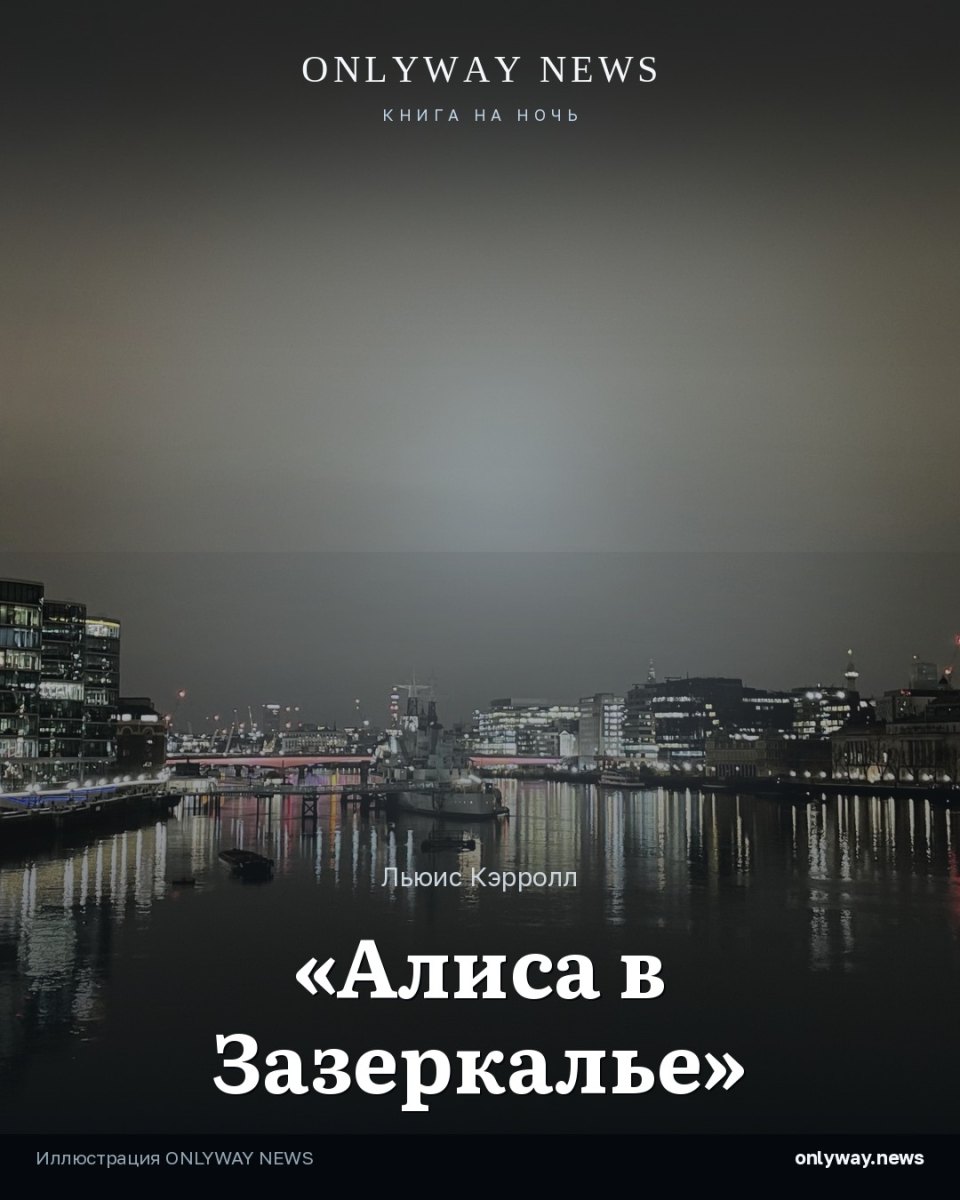
Through the Looking-Glass, and What Alice Found There (1871) is Lewis Carroll’s second Alice book and, many think, the stranger and more grown-up of the two. On a snowy winter evening, playing with her kittens by the fire, Alice climbs through the mirror above the mantelpiece into a back-to-front world laid out like a game of chess: talking flowers, Tweedledum and Tweedledee, the gentle, forever-falling White Knight, Humpty Dumpty, and the poem “Jabberwocky,” which can only be read in a mirror. It is a book-as-game where everything runs backwards and logic is turned inside out — and, at the same time, a tender tale about growing up. Perfect reading for a winter evening: short chapters, each one a new room of the Looking-Glass world.
The opening: how the book begins
The book opens with a homely, cosy scene — Alice, the fire, and a serious inquiry into who unwound the ball of wool:
“One thing was certain, that the white kitten had had nothing to do with it:—it was the black kitten’s fault entirely.”
Translation by ONLYWAY NEWS; original in the public domain via Project Gutenberg.
Then comes the hook: Alice climbs onto the mantelpiece, the glass of the mirror turns soft as a silvery mist, and she steps through it into a room where everything is reversed — the clock has a grinning face, the books are written backwards, and the fire burns just as it does at home. That single step begins the most famous journey to the other side of the glass. Read the full text of Through the Looking-Glass in English — Project Gutenberg, eBook #12.
Why it is worth reading today
Looking-Glass is often underrated beside Wonderland, and unfairly so: it is the 19th century’s most inventive children’s book about how language and logic really work. The whole world is a chessboard, and Alice moves from pawn to queen past talking flowers, quarrelsome twins and the White Knight, who keeps tumbling off his horse — the kindest and saddest character in the book. Grown-ups reread it for the play of mind: “Jabberwocky,” the argument with Humpty Dumpty about who is master of words, the running-to-stay-still with the Red Queen. For a child it is simply glorious nonsense, where you may believe impossible things before breakfast. The first chapter, “Looking-Glass House,” is short: Alice, the kittens and the passage through the mirror take about fifteen minutes to read aloud — just enough to fall asleep already on the other side of the glass. We will not spoil the ending: let each reader decide whose dream it was.
About the author
Lewis Carroll was the pen name of Charles Lutwidge Dodgson, an Oxford mathematician. He was born on 27 January 1832 in the village of Daresbury, Cheshire, and died on 14 January 1898 at his sisters’ house in Guildford. Three things worth knowing. First, he spent his working life teaching mathematics at Christ Church, Oxford, and wrote serious works on logic, turning out fairy tales almost on the side. Second, Alice grew from a real child — Alice Liddell, the daughter of the college’s Dean, to whom Dodgson told stories during boating trips on the river at Oxford. Third, he was one of the finest photographers in Victorian England. He wrote Looking-Glass six years after Wonderland, already sensing that these two books would outlive all his mathematics.
Walk the places
Christ Church, St Aldate’s, Oxford OX1 1DP. The college where Dodgson taught mathematics and invented Alice; its Great Hall is one of the most famous in England. In the Michaelmas term (until 12 December 2026) it is open Mon–Sat from 10:00, exit by 17:00, Sun from 14:00; the Great Hall is closed Mon–Fri 12:00–14:00 and Sat 10:30–14:00 — worth planning around. A multimedia guide is included and required. Tickets (weekday / weekend): adult £22.95 / £24.95, child 5–17 £17.50 / £19.50, students and 65+ £20.50 / £22.50, under-5s free; booking online in advance saves £2. Tickets are released each Friday about 10:00 for the following week, so book ahead.
 ADV · A003We build websites for tradespeople and sole traders — £219Customers see your work and prices and message you straight away. Ready in 3 days, £219 instead of £438.Advertise here
Alice’s Shop, 83 St Aldate’s, Oxford. Directly across from Christ Church — the very shop that became the Sheep’s little store in Looking-Glass (chapter 5), where the shelves keep rearranging themselves. Today it is a tiny Alice-themed gift shop; you can step in and look around for free.
Guildford, Surrey. The town where Carroll spent his last years, died and is buried (the Mount Cemetery). In the grounds of Guildford Castle stands a bronze of Alice stepping through the looking-glass — an open-air sculpture you can visit any time for free; the castle grounds themselves are a public park.
Where to find it
Free. The full English text is on Project Gutenberg: Through the Looking-Glass (eBook #12), legal and in the public domain (Carroll died in 1898). For a printed copy, search your library through the union catalogue Library Hub Discover.
Buy. In Russian, Alice in the Looking-Glass appears in many editions — most often the classic translation by Nina Demurova, usually bound together with Wonderland. In English, it is stocked by Blackwell’s and any large bookshop. London’s Russian bookshops — Pushkin House Bookshop (Bloomsbury), Notre Locus and Bookashka — can order it.
Thanks for £1If this information was useful and came in time, press the heart. Payment goes through PayPal, with nothing to choose and nothing to fill in, and it pays for the newsroom.
- Through the Looking-Glass by Lewis Carroll — Project Gutenberg, eBook #12 (полный текст в общественном достоянии; первая фраза)
- Lewis Carroll — Wikipedia (даты жизни, Крайст-Чёрч, Алиса Лидделл)
- Through the Looking-Glass — Wikipedia (1871, шахматная структура, персонажи)
- Christ Church, Oxford — Visit (часы работы и цены; проверено 21.11.2026)
- Guildford — Wikipedia (Кэрролл умер в Гилдфорде; бронзовая Алиса в парке у замка)
- Life Nemnogo Nervno’s Kateryna Gopenko plays London on 20 November
- Tax Self Assessment: 31 Jan deadline
- Money Do marketplace warehouses give goods away free? The truth about unclaimed parcels
- Life Russian-speaking doctors and clinics in London: eight addresses checked against the registers
- Books Book at bedtime: Pride and Prejudice and the price of a good match
- Immigration UK Standard Visitor Visa in 2026: Rules, Fees and Duration
- Jobs & Business Post Your Ad Free