The Fourth Plinth: who gets there, how, and for how much
The programme costs £1.03m over three years and about £230,000 per commission: a £30,000 artist fee and £200,000 for production — a fixed sum, not a ceiling. Three selection stages, maquettes shown at the National Gallery, a specialist panel decides and there is no public vote. The full list of works since 1999, and an honest answer to why not everyone gets there.
Thanks for £1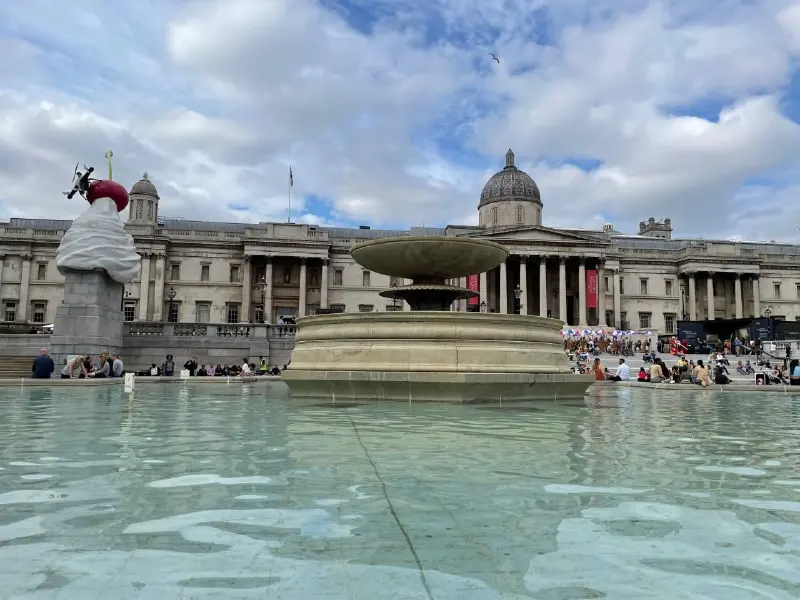
The empty plinth in the corner of Trafalgar Square is the best-known shop window for contemporary art in Britain. A new work appears every two years, and every one of them starts an argument. Here is who gets there and how, what it costs, who pays, and why you cannot simply turn up with a sculpture of your own.
Where did the empty plinth come from?
It was built in 1841 by Charles Barry, the architect of the Palace of Westminster, to carry an equestrian statue of King William IV. The money for the statue was never raised, and the plinth stayed empty. For a century and a half.
 ONLYWAY NEWSLIVEHousing · 20.10Deposit withheld for wear and tear: where the line isMoney · 20.10Universal Credit: what you get, and why earning cuts it by 55pLife · 20.10A child passport in the UK: £66.50 online, £80 on paper, five years' validityLife · 20.10Health and your licence: what you must tell DVLA, and the cost of not tellingJobs & Business · 20.10Unpaid parental leave: 18 weeks per child and 4 weeks a yearLaw · 20.10Shop theft in England: seven years maximum, the truth about £200 and what the 2026 Act changesLife · 20.10Medical cannabis in the UK: who can prescribe it and for whatJobs & Business · 20.10Redundancy in the UK: up to £22,530, 12 weeks' notice and six months to claimBooks · 20.10Poetry London in a day: a museum, a poets' cafe, a library and an abbeyLife · 20.10A degree from elsewhere: who converts it into Britain's language of qualifications, and what that costsONLYWAY NEWS · appInstall the ONLYWAY NEWS appFresh UK news, classifieds, key dates and exchange rates on your home screen, one tap away. Free.NewsClassifiedsCalendarRates
Proposals for who should stand there surfaced from time to time, and each time either the money or the agreement fell short. In 1998 the Royal Society of Arts suggested something simpler: instead of choosing anybody permanently, show contemporary art in rotation. In 2003 the site passed to the Mayor of London and the Mayor's Fourth Plinth Commission was created.
What does it cost and who pays?
The figures are published, because it is public money. The 2024–27 programme costs £1.03 million: £780,000 of GLA revenue funding, £250,000 of capital, up to £75,000 from Arts Council England, and up to £250,000 sought from sponsors.
Roughly £230,000 goes to each commission:
- £30,000 — the artist's fee, paid in instalments, plus travel and accommodation.
- £200,000 — the production budget: materials, casting, engineering, transport.
One detail explains a great deal: the production budget is a fixed sum, not a ceiling. If the work costs more, the artist finds the difference. So what reaches the plinth is what can actually be built for that money — and almost never a vast, expensive construction.
The rest of the programme budget covers installation and project management (£285,000 over three years), the schools award for children (£100,000), and marketing and public engagement (£335,000).
 ADV · A001ONLYWAY JEWELRY — gold, silver and platinumRings, chains, bracelets, earrings and pendants. Delivery across the UK.Advertise here
How is the choice made?
Stage one. An artist submits a sketch proposal — no more than two A2 sheets and 500 words. In parallel, the longlist is assembled by the Commissioning Group together with invited international nominators, curators and specialists who put names forward. Stage-one participation pays £1,000.
Stage two. Six or seven artists produce maquettes, a fuller statement of up to 1,000 words, a budget and a feasibility study. The fee for this stage is £6,000. The maquettes go on public show, usually in the National Gallery directly opposite the plinth, and anyone can go and see what is proposed.
Stage three. The decision is taken by the Fourth Plinth Commissioning Group, a panel of specialists chaired for many years by the curator and writer Ekow Eshun. The Mayor of London confirms the choice.
The work must survive open air and London weather for at least twenty-four months. That is an engineering requirement, not a preference.
Why their work and not yours?
The honest answer: this is not an open competition in the ordinary sense, even though anyone may formally submit a sketch.
Three filters decide it. First, reputation: the longlist is largely shaped by nominators, who put forward artists with established names. Second, buildability: the work has to be cast, transported and installed for a fixed £200,000, and then stand for two years in the wind in the middle of a square that tens of thousands of people cross every day. Third, there is no public vote: opinion is gathered at the maquette exhibition, but specialists choose.
The route there runs through a career rather than an application form — exhibitions, institutions, curators who know your work. You can call that unfair, but it is set out openly in the programme's own documents rather than hidden.
What has stood there over the years?
1999 — Mark Wallinger, Ecce Homo. A life-size figure of Christ that looked tiny on the huge plinth. That contrast was the statement.
2000 — Bill Woodrow, Regardless of History. A head, a book and tree roots grown together.
2001 — Rachel Whiteread, Monument. A clear resin cast of the plinth itself, set on top of it upside down. A monument to emptiness.
2005–2007 — Marc Quinn, Alison Lapper Pregnant. A marble figure of the pregnant artist, born without arms. The most controversial work in the site's history and probably the most important.
2007–2009 — Thomas Schütte, Model for a Hotel. A glass architectural model that changed colour with the weather.
2009 — Antony Gormley, One & Other. For a hundred days, around the clock, an ordinary person stood on the plinth for an hour each. 2,400 people took a turn: some read poetry, some stood in silence, some undressed. A living monument instead of a bronze one.
2010–2012 — Yinka Shonibare, Nelson's Ship in a Bottle. A replica of HMS Victory with sails of African print fabric, inside a glass bottle. It now stands outside the National Maritime Museum in Greenwich, free to see.
2012–2013 — Elmgreen & Dragset, Powerless Structures, Fig. 101. A boy on a rocking horse, where a general on a war horse would be.
2013–2015 — Katharina Fritsch, Hahn/Cock. An ultramarine cockerel four and a half metres high. The public took to it faster than to anything else.
2015–2016 — Hans Haacke, Gift Horse. A horse's skeleton with a live electronic ticker of London Stock Exchange prices bound to its leg.
2016–2018 — David Shrigley, Really Good. A seven-metre thumbs-up with an unnaturally long thumb. A joke about compulsory optimism.
2018–2020 — Michael Rakowitz, The Invisible Enemy Should Not Exist. The Assyrian winged bull destroyed by ISIS in Mosul, recreated from 10,500 empty Iraqi date syrup cans.
2020–2022 — Heather Phillipson, THE END. A mound of whipped cream with a cherry, a fly and a drone streaming a live view of the square.
2022–2024 — Samson Kambalu, Antelope. A restaging of a 1914 photograph: the Nyasaland Baptist preacher John Chilembwe in a hat — forbidden to Africans at the time — beside a European missionary. Chilembwe is made twice life size.
2024–2026 — Teresa Margolles, Mil Veces un Instante. 850 plaster casts of the faces of trans people and women, stacked into a wall.
2026–2028 — Tschabalala Self, Lady in Blue. A bronze figure of a young Londoner patinated lapis lazuli blue. Currently in place.
From 2028 — Andra Ursuţa. Chosen in the same round; the work is not yet installed.
What happens to the works afterwards?
The plinth is temporary; the sculptures are not. What follows varies: Nelson's Ship was bought for the National Maritime Museum, Really Good and Hahn/Cock moved on to other sites and private collections, some works go back to the artist. City Hall does not keep them — the programme funds making the work, not building a collection.
How can you see it?
Trafalgar Square, north-west corner, nearest tube Charing Cross. Free, at any hour, no ticket. The maquettes for future commissions are exhibited in the National Gallery, where entry to the permanent collection is also free.
One thing worth knowing separately: the programme runs a Fourth Plinth Schools Award, in which London schoolchildren submit their own designs for the plinth and the best are exhibited. If you have children at a London school, this is the rare case where entry is free and genuinely open.
Read next: Autumn in London's museums: what closes, what opens and how… · Britain's autumn sky: a calendar of meteor showers,…
Thanks for £1If this information was useful and came in time, press the heart. Payment goes through PayPal, with nothing to choose and nothing to fill in, and it pays for the newsroom.
- Housing Drought: minister lets the Agency take more water to avoid rota cuts
- Travel Jubilee line part suspended to Stanmore after fire alert
- Life A London concert cancelled back in March is still on sale for 4 October — and the full Russian-language listings for October
- Life Russian-language events in London: verified dates to December 2026
- Travel London Tube and TfL closures in October 2026: the Piccadilly line stops entirely at Halloween, and no Tube to Heathrow on 17–18 October
- Housing Homes in London take 84 days to sell — longest in Britain
- Jobs & Business From 1 October, right to work checks reach couriers, subcontractors and platform workers