Britain's autumn sky: a calendar of meteor showers, supermoons and dark nights
From 23 September to 22 December: six meteor showers in a row, two supermoons and the clock change that brings darkness by five in the afternoon. Dates, the best nights, dark sky sites and what to take.
Thanks for £1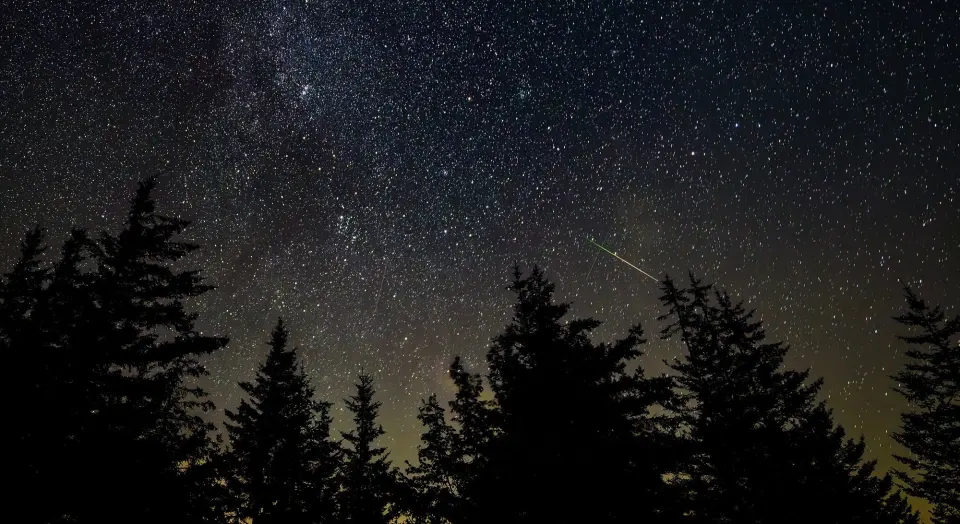
Autumn is the only season in Britain when you can look at the sky without losing sleep. It gets dark early, the air after rain is clear, and September to December brings six meteor showers in a row plus two supermoons. Below is the calendar, and the practical part: where to go and what to take.
When does it get dark early enough in autumn?
Astronomical autumn begins on 23 September at 01:06 British Summer Time, when the Sun crosses the celestial equator and the night becomes longer than the day.
 ADV · A003We build websites for tradespeople and sole traders — £219Customers see your work and prices and message you straight away. Ready in 3 days, £219 instead of £438.Advertise here
The second turning point is 25 October, the last Sunday of the month: at 02:00 the clocks go back an hour and the country returns to GMT. From then on it is dark in London by about five in the afternoon, and by December closer to four. For observing, that means heading out straight after work rather than at midnight.
Which meteor showers run this autumn, and when do they peak?
Peak dates and expected hourly rates from the Royal Observatory Greenwich:
Draconids — peak 9 October, active 6-10 October, about 10 meteors an hour. Associated with Comet 21P/Giacobini-Zinner. Unusually, evening is better than the small hours.
Southern Taurids — peak 10 October, active 10 September to 20 November, about 5 an hour. Very slow meteors, but often bright.
Orionids — peak 21 October, active 2 October to 7 November, about 15 an hour. Debris from Halley's Comet: fast, with fine trains.
Northern Taurids — peak 12 November, active 20 October to 10 December, about 5 an hour.
Leonids — peak 18 November, active 6-30 November, about 15 an hour. Associated with Comet Tempel-Tuttle; fast and bright.
Geminids — peak 14 December, active 4-20 December, up to 120 an hour. The most generous shower of the year: plenty of bright meteors, few trains.
Ursids — peak 22 December, active 17-26 December, about 10 an hour. A sparse shower, associated with Comet 8P/Tuttle.
When are the supermoons?
There are three supermoons in 2026, and two of them fall in autumn and early winter: 24 November and 24 December. A perigee full Moon looks around 14% larger and 30% brighter than an apogee one — though the difference against the full Moon of the neighbouring month is essentially imperceptible.
The practical side matters more than the spectacle: a bright Moon washes out the sky and kills meteor watching. The Leonids on 18 November land in an awkward window before the 24 November supermoon, while the Geminids on 14 December fall in a dark phase.
Where is the sky genuinely dark in Britain?
In London, or any large city, light pollution leaves only the Moon, the planets and a dozen bright stars. You cannot watch a meteor shower from the middle of a city — that is not a weather problem.
Closest to the capital is the South Downs National Park, an International Dark Sky Reserve about an hour and a half away. Further afield: Exmoor, Bannau Brycheiniog (Brecon Beacons), Eryri (Snowdonia), the North York Moors and Yorkshire Dales, and Cranborne Chase. Northumberland has Europe's largest dark sky park, with the public Kielder Observatory; Scotland has Galloway Forest Park.
If travel is not an option, a simple rule still works: any spot beyond the city edge where you stand with your back to the urban glow already makes a visible difference.
What should you take, and how do you watch?
A telescope is unnecessary for meteor showers and actively unhelpful: it narrows the field of view. Watch with the naked eye, taking in as much sky as possible.
Eyes need about 20 minutes to adapt to darkness, and one second looking at a phone to lose it. If you need light, use a torch on red.
Look not straight at the radiant but about 40-60 degrees to one side, where the trails are longer. Bring a folding chair or mat, a flask, and twice as much clothing as seems necessary — an hour lying still in a November field gets cold fast.
And the key British condition: check the cloud forecast the night before and keep a backup date. Most showers stay active for days, and the peak is not the only chance.
Read next: The Bayeux Tapestry in London: how to get in · Sunday in London: where to go
Thanks for £1If this information was useful and came in time, press the heart. Payment goes through PayPal, with nothing to choose and nothing to fill in, and it pays for the newsroom.

- Housing Drought: minister lets the Agency take more water to avoid rota cuts
- Markets UK firms set for more than £330m in export contracts in Guinea and Benin
- Life A London concert cancelled back in March is still on sale for 4 October — and the full Russian-language listings for October
- Jobs & Business From 1 October, right to work checks reach couriers, subcontractors and platform workers
- Housing Damp and mould in a rented flat: strict repair deadlines are coming to private landlords
- Life Russian-language events in London: verified dates to December 2026
- Books Book at bedtime: Pride and Prejudice and the price of a good match