City dragons: why fourteen
Black dragons at Bank aren't griffins. Fourteen mark the City boundary and bear its arms. Why so many.
Thanks for £1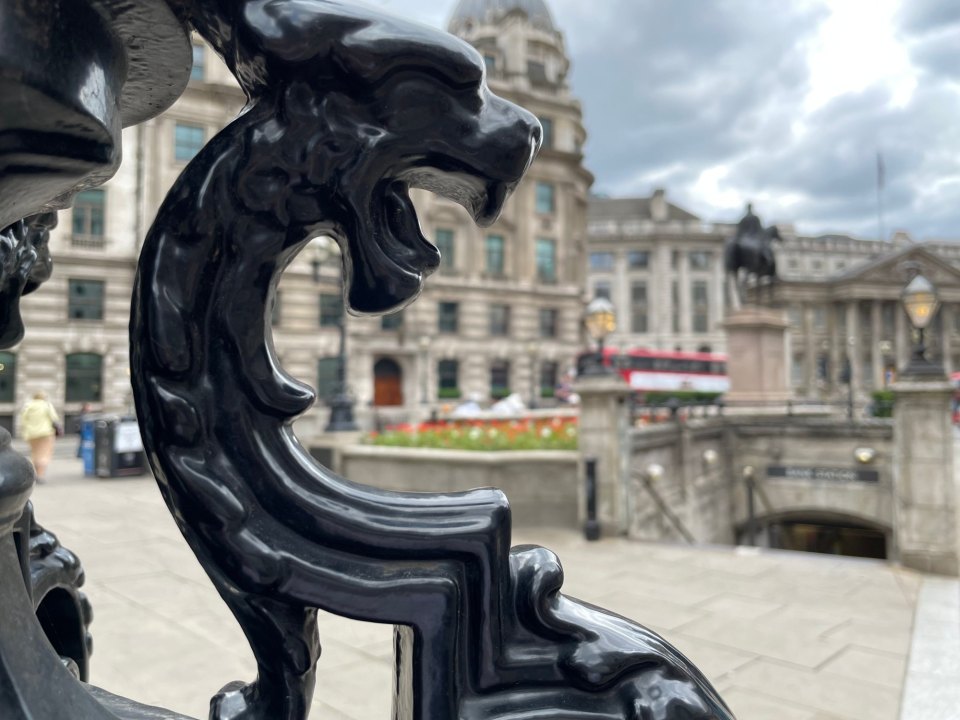
The snarling black dragon by Bank station is no random beast and no one-off decoration. It is a guardian of the City, and there are many of them in central London. Let us sort it out calmly: is it a dragon or a griffin, how many are there, what do they guard, and why are there so many dragons in Britain at all.
Is it a dragon or a griffin?
It is a dragon, though it is constantly mistaken for a griffin. It is easy to tell them apart: a dragon has scales, membranous wings, a serpentine body and clawed feet. A griffin is an eagle with a lion's body: a beak, feathers, lion's paws. The City figures have a beastly muzzle, a scaly body and leathery wings — a classic heraldic dragon.
What do they guard?
You are standing by Bank — this is the City, the "Square Mile", the financial centre and the oldest self-governing part of London, with its own lord mayor and police. The dragon is the official guardian and emblem of the City. In its claws it holds a shield with the city's arms: a red St George's cross on white, with a red sword in the top corner. Put simply, the dragon marks where the City begins.
 ADV · A001ONLYWAY JEWELRY — gold, silver and platinumRings, chains, bracelets, earrings and pendants. Delivery across the UK.Advertise here
How many are there, and where?
There are exactly 14 boundary dragons at the roads entering the City. Thirteen follow the design of the dragons from the old Coal Exchange, and the biggest and fiercest stands at Temple Bar (1880, by the sculptor Charles Bell Birch). Two 1849 originals were moved to the Victoria Embankment in 1963 after the exchange was demolished. The boundary dragons are usually silver with red wings; the black one in the photo is decorative, by the Royal Exchange.
Why so many dragons in Britain?
Three traditions meet here. First, England's patron saint George slaying the dragon: hence the red cross on the flag and on the City's shield. Second, the red dragon of Wales (Y Ddraig Goch), an ancient symbol right on the national flag. Third, heraldry: the dragon was a "supporter" of the arms of cities and noble families, including the Tudors. So in Britain the dragon appears as a religious subject, a national sign and a coat of arms alike.
Why it's fun, and what it costs
For a visitor it is a free quest: finding all 14 dragons means working out where the City's invisible boundary runs. The figures are protected as listed monuments, looked after by the City of London Corporation, and restoring each costs thousands of pounds. So a "dragon walk" is both a fine free tour and a way to feel what sets the City apart from the rest of London.
Thanks for £1If this information was useful and came in time, press the heart. Payment goes through PayPal, with nothing to choose and nothing to fill in, and it pays for the newsroom.

- Tax Self Assessment: 31 Jan deadline
- Money Do marketplace warehouses give goods away free? The truth about unclaimed parcels
- Law Yellow and red kerb lines: UK rules
- Life Royal week: Prince George starts at Eton, Prince William at King Harald's funeral
- Immigration UK Standard Visitor Visa in 2026: Rules, Fees and Duration
- Immigration UK visitor visa step by step 2026: timing, cost, biometrics and how long it takes
- Life Use by vs best before dates