Advertising on the Tube: prices
The Tube earns ~£150m a year from advertising. Who sells it, what a board costs, and can a business get in.
Thanks for £1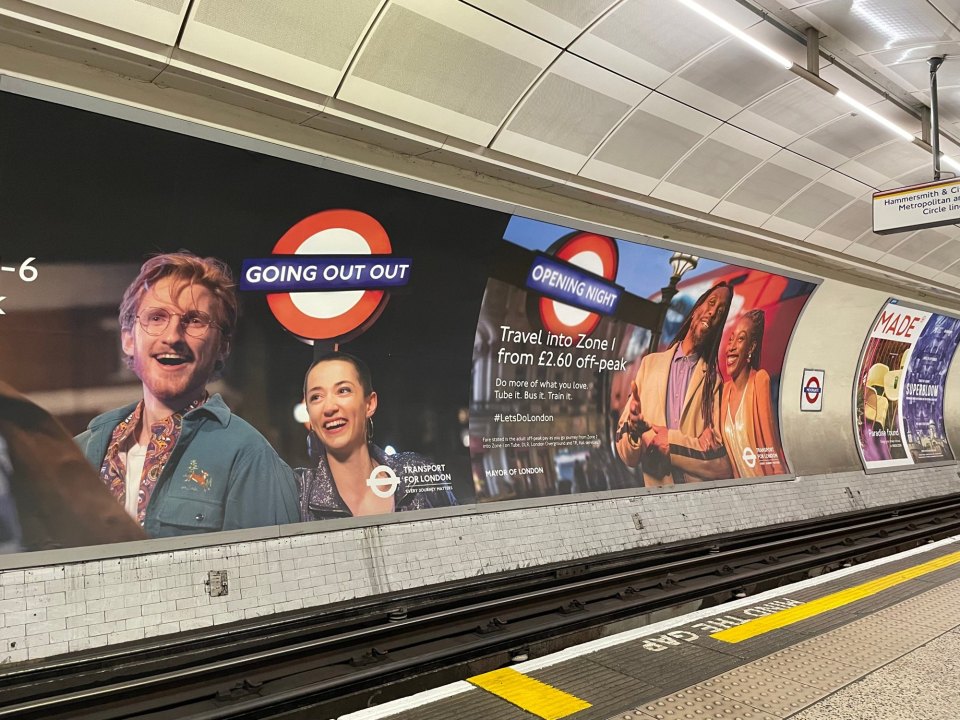
The long advertising panels along the platform that passengers study while waiting for a train are one of Britain's most expensive and profitable ad markets. Advertising on the London Underground brings the transport system hundreds of millions of pounds a year. Here it is in business terms: who sells it, what it costs to run, who is the main beneficiary, and whether an ordinary business can get in.
How much does the Tube earn from advertising?
Transport for London (TfL) earns about £150m a year from commercial income — mostly advertising. It is a serious line in the budget: the money goes not to shareholders but back into transport, helping hold down fares. So the main beneficiary of Tube advertising is TfL itself and, indirectly, passengers. The ad in the photo, as it happens, is TfL's own: the "Going Out Out" campaign urging people to travel in the evening and off-peak (into Zone 1 from £2.60).
Who sells advertising on the Tube?
TfL does not sell the advertising itself — it hands it to big media companies under concession. In 2024 two firms won the new contracts: Global took the rail network (Tube, Overground, DLR, trams and the Elizabeth line), and JCDecaux took bus-shelter advertising. The market puts these contracts together at roughly £2.5bn over their term. The deal runs for eight years, with an option to extend by two more.
 ADV · A003We build websites for tradespeople and sole traders — £219Customers see your work and prices and message you straight away. Ready in 3 days, £219 instead of £438.Advertise here
How many advertising sites are there?
The scale is huge. On paper posters alone there are more than 9,000 panels across the network, plus 612 digital screens, and on the bus side over 4,700 shelters carry advertising. The ads are seen by millions of people a day — which is exactly why the space is dear: it is not just a picture but a guaranteed contact with a vast flow of people who can't get away from the board while they wait for a train.
What does it cost to run an ad?
It depends on the format, but the entry point is more realistic than it looks. Tube advertising is sold in two-week slots. A single small "4-sheet" poster by an escalator costs £150–195, a larger 6-sheet £400–520, a cross-track board from £500 for two weeks. Car panels inside trains start at £10–13 each, but the minimum order is 550 panels, so about £7,000–9,100 for a campaign. A full station "domination" runs into tens and hundreds of thousands of pounds.
Can an ordinary business get in?
Yes. A single poster by an escalator at £150–200 for two weeks is within reach even of a small firm — a café, shop or salon near the station. The key is to count not the "look" but the return: how many people actually come because of the ad. For a local business it is more effective to take stations near you than to scatter the budget across the whole city. Placements are usually booked through an ad agency or directly with the concessionaire.
How is this useful to the reader?
First, you now know where the money goes: Tube advertising is not a nuisance but a way to keep fares cheaper. Second, it is a working tool for business: for £150–200 you can try advertising where thousands of people see it. And for an advertiser the main tip is to start with one or two stations near the point of sale and honestly count whether the board paid off, rather than chasing reach across all of London.
Thanks for £1If this information was useful and came in time, press the heart. Payment goes through PayPal, with nothing to choose and nothing to fill in, and it pays for the newsroom.

- Tax Self Assessment: 31 Jan deadline
- Money Do marketplace warehouses give goods away free? The truth about unclaimed parcels
- Law Yellow and red kerb lines: UK rules
- Life Royal week: Prince George starts at Eton, Prince William at King Harald's funeral
- Immigration UK Standard Visitor Visa in 2026: Rules, Fees and Duration
- Immigration UK visitor visa step by step 2026: timing, cost, biometrics and how long it takes
- Life Use by vs best before dates